Thursday, 24 May 2012

Rapt Brahms from philosopher-virtuoso Volodos

Franz Schubert: Piano Sonata in A minor, D.784
Johannes Brahms: 3 Intermezzi, Op.117
Franz Liszt: Sonata in B minor
Arcadi Volodos piano

22 June 2012, Royal Festival Hall, London
***************

Anyone who has encountered the Sony recordings of Russian virtuoso Arcadi Volodos will know what an imposing musical personality he is.  But for London audiences he is only just starting to make regular appearances.  He started with a smooth and fluid Tchaikovsky First Piano Concerto in 2010 with the Leipzig Gewandhaus Orchestra at the Barbican.  However Tuesday's recital displayed the full range of his wares.  

Arcadi Volodos
The Schubert Sonata D784 is a bleakly beautiful piece and right from the start Volodos cast an immediate spell which only the most determined coughers in the audience could resist.  He is unafraid of playing quietly and slowly, inviting the listener to enter his sound world, slow to his heartbeat and philosophise with him. 

The Opus 117 Intermezzi proved the genial highlight of the recital - classic Autumnal Brahms.  Volodos took a very broad and introspective approach.  It might have dragged.  Instead it was riveting. What oceans of rich tone he conjured from the piano, even at low dynamic levels.   The instrument purred and glowed and Brahms' full textures were lovingly guided and piled up.  Masterly.

The Liszt Sonata would have benefited from a firmer grip on the overall arc of the work.  Volodos pulled the dynamics around a lot, disturbing the underlying pulse and emphasising its tendency to feel episodic.   But what pianism!  Volodos has the kind of dynamic range which most pianists can but dream of.   His bass chords could be massive fortissimo eruptions or hushed and ominous intrusions - evoking dusty, windswept grave-yards.  Even at pace and volume he never played through his tone.  There were no rough edges in this sound-world.

Want to know more about this highly individual and prodigious artist?  Look no further than his astonishing 2006 Liszt disc on Sony with the Vallee d'Obermann and his own arrangement of the 13th Hungarian Rhapsody.  Technically, Volodos is the rare type of pianist for whom the phrase "super-virtuoso" is made.  Combined with his intensely personal and original musical vision he is, at 40, a musical talent to follow with great interest.   

Peter O'Byrne

Friday, 18 May 2012

Mariss Jansons cancels conducting lecture

Leading conductor Mariss Jansons was due for a double of events at London's Barbican Centre last weekend.  On Saturday 12 May an all-Strauss concert with his Concertgebouw Orchestra Amsterdam, and on Sunday afternoon 13th a conducting lecture/masterclass.  

However, ill-health meant the interval at the Strauss was longer than normal and then at 10am on the Sunday those like me that were to attend the lecture received this email: 

"Thank you for booking tickets for the Mariss Jansons and Peter Blaha Conducting MasterClass at LSO St Luke's today at 3pm. Owing to the indisposition of Mariss Jansons it has been necessary, at very short notice, to cancel this event."

For those who know Janson's medical history, the word "indisposition" is certainly not code for "had a heavy night".  Jansons father, Arvids Janssons, died of a heart attack while conducting an orchestra and Mariss Jansons himself also had a heart attack back in 1997 while directing La Boheme.  Jansons is both the very greatest conductor before the musical public and the most fragile.  May he have a speedy return to health.

Saturday, 28 April 2012

Review - Solemnity and acclaim as Harnoncourt receives the  RPS Gold Medal

Beethoven Missa Solemnis, Opus 123

Royal Concertgebouw Orchestra of Amsterdam
Nikolaus Harnoncourt - conductor 
Marlis Petersen - soprano
Elisabeth - Kulman alto
Werner Güra - tenor
Gerald Finley - bass
Groot Omroepkoor (Dutch Radio Chorus)

22 April 2012, Barbican Hall, London
*****************

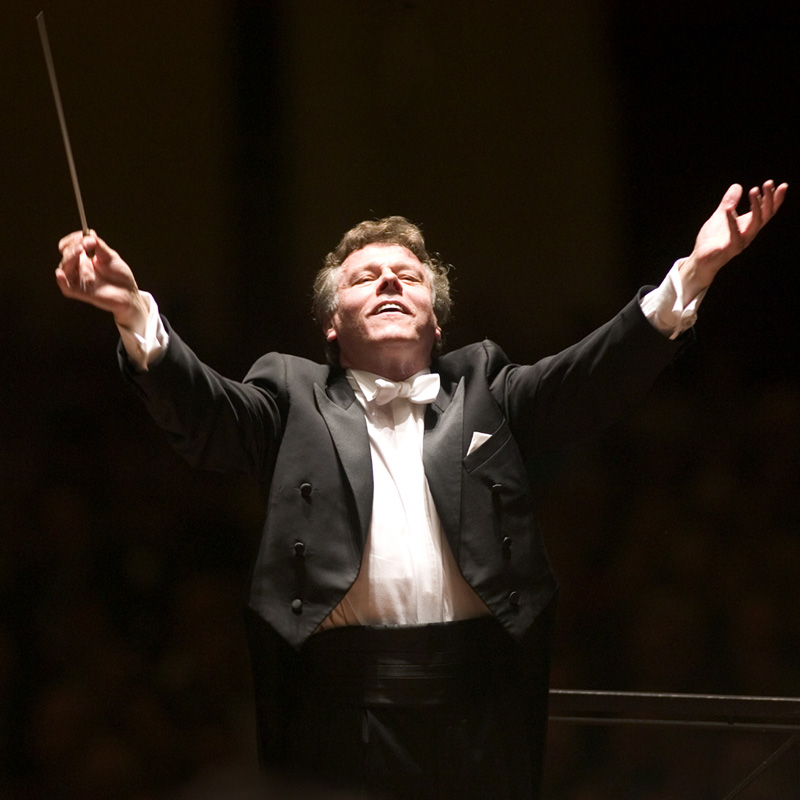
Nikolaus Harnoncourt
Conductor Nikolaus Harnoncourt is a rare visitor to London, so the prospect of him directing Beethoven's epic Missa Solemnis with that Rolls Royce of orchestras - the Concertgebouw - was mouth-watering.  And it was a high-fibre audience that attended.  In my immediate vicinity at the Barbican were the directors of the Proms Festival and the Barbican Centre and the conductor Semyon Bychkov.

An ideas man, Harnoncourt was sure to be at his best in a work teeming with ideas.  Beethoven famously deploys military march interjections in the concluding Agnus Dei to undercut the prayer for peace in the mass text. However it was with an aura of calm that the performance was conducted.  With reverence and clarity, Harnoncourt directed his forces.  Not for him the excitable gear changes of others in this massive composition that Beethoven composed over 5 years towards the end of his life.  Originally intended for the enthronement of his patron Archduke Rudolph in 1820, Beethoven did not finish the work until 1823 and at 80+ minutes it reaches far beyond any practical liturgical purpose.

Not that it was leaden: the underlying dance rhythms were brought out, the Sanctus flowed smoothly and the Agnus Dei was as intense and draining as it should be.  Harnoncourt's vision was supported to the hilt by his very fine musicians: the Concertgebouw Orchestra was supple and refined, the Dutch chorus did not flag in a taxing work, and the soloists kept the histrionics to a minimum, producing a beautifully blended sound as a quartet.  Elisabeth Kulman's mezzo was nicely dark and withdrawn, while Gerald Finley's baritone entry in the Agnus Dei worked hard to not stand out too much from the chorus directly behind him. 

This was commmunal music making of a high standard and it was fitting that this preceded the presentation that followed.  At the end John Gilhooly (director of Wigmore Hall and President of the Royal Philharmonic Society) presented Harnoncourt with the RPS Gold Medal.  This must surely be one of the 2 or 3 most revered prizes for a musician.  It has been awarded since 1870 to commemorate Beethoven's birth in 1770 and its recipients are most exalted: Brahms, Richard Strauss, Elgar, Stravinsky, Bernstein and current leading musicians including Barenboim, Domingo and Boulez.  Harnoncourt's career leading the period performance movement and then transferring much of that skill to modern as well as period instrument orchestras places him centrally in the development of orchestral performance since the 1960s.

Harnoncourt's speech was a model: paying tribute to the composers without whom he could do nothing "for I cannot write a note!", he then accepted the award on behalf of all the musicians he has worked with for 60+ years because "without them I am but dust".

Tuesday, 24 April 2012

Review - Berliner Staatskapelle and Barenboim triumphantly conclude Bruckner week

Wolfgang Amadeus Mozart: Piano Concerto No.22 in E flat, K.482
Anton Bruckner: Symphony No.9

Staatskapelle Berlin
Daniel Barenboim conductor

20 April 2012, Royal Festival Hall, London
********************

Daniel Barenboim and the Staatskapelle Berlin brought their week long residency to a close with the last and most awe inspiring of the lot - Bruckner's 9th Symphony - and a well deserved ovation.
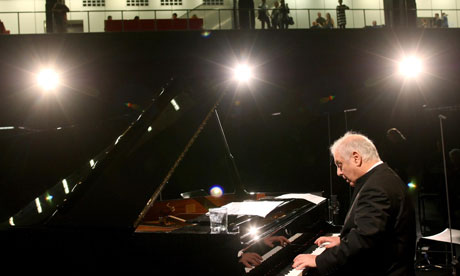
Barenboim in (much) earlier days

They first brought great style and poise to Mozart's 22nd Piano Concerto.  Easily one of Mozart's best concertos, it contains unusual lyrical interludes for the woodwinds where the Staatskapelle players shone.  Barenboim's playing was equal to his orchestra - affectionate, spontaneous and revelling in the contrasts of the score.
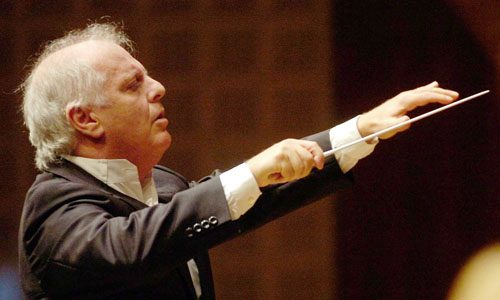
...and in 2011
Barenboim chose some daringly spacious speeds for the Bruckner 9th.  The 9th remains incomplete with the fourth movement finale not finished at his death, but its 3 completed movements still make it perhaps the most far-reaching and profound of Bruckner's works.  The Staatskapelle were in fine form again in maintaining the line and tension, and produced richly satisfying Brucknerian climaxes.  The scherzo was tight, sinister and detailed.  The blazingly dissonant chord that marks the peak of the adagio was a perfect musical moment: punched out with all parts of the orchestra marvellously blended from the timpani through brass and woodwind to the strings.  Barenboim added his bit by extending the time the chord is held.  It was shattering, and its memory the perfect backdrop for the concluding pages.

This was a special concert to close a great Brucknerian week in London.  The appeal was multi-faceted: the poetic gift of Mozart, the cosmic ambition of Bruckner's 9th, the close partnership of the Staatskapelle Berlin and their chief conductor, and Barenboim's own personal connection with the London musical public. 

Thursday, 19 April 2012

Review - Bruckner 8th Symphony played by Staatskapelle Berlin

Anton Bruckner: Symphony No.8
Staatskapelle Berlin
Daniel Barenboim
conductor

17 April 2012, Royal Festival Hall, London
********************

Daniel Barenboim
After Monday's Bruckner 7th Symphony, Tuesday brought the biggest of the lot - the dark and mighty 8th played in solitary splendour with no accompanying Mozart concerto.

While many claim this is the greatest Bruckner symphony (I would say one of 5 or 9 myself), the 8th has eluded many seasoned Bruckner conductors.  Tuesday's concert again highlighted the joys of the Barenboim/Staatskapelle Berlin partnership.  They know eachother well so they can bring out the ebb and flow of Bruckner's works in the moment, and these concerts also bear the hallmarks of careful preparation. Bruckner again emerged with freshness without lacking weight.  Aside from some occasional discomfort in the brass and a lack of shape at the climax of the adagio, the playing was again of a very high standard.  Thinking back to the wonderful Lucerne Festival Orchestra concert of Bruckner's 5th Symphony conducted by Claudio Abbado, the Lucerne players had the edge in terms of sheer orchestral refinement.  However it is the Barenboim/Staatskapelle partnership that is producing the more engaging and thrillingly spontaneous interpretations.  This Friday the "Bruckner project" concludes with the 9th Symphony. I can't wait.

Monday, 16 April 2012

Review - Barenboim's Bruckner Project starts at Southbank

Wolfgang Amadeus Mozart: Piano Concerto No.24 in C minor, K.491
Anton Bruckner: Symphony No.7

Staatskapelle Berlin
Daniel Barenboim
conductor, piano

16 April 2012, Royal Festival Hall, London

*********************

Barenboim is on a roll at London's Southbank centre.  His 2008 performances of the 32 Beethoven sonatas were a major musical landmark.  They married powerful artistry with his particular star charisma and I've rarely seen a London audience receive a musician so rapturously. For once it was fully justified.

2010 brought fine performances of the 5 Beethoven piano concerti with his Berlin Staatskapelle orchestra. The only recent blot has been a splashy Liszt Piano Concertos evening with Boulez last year which for all its posturing rather sat back on its heels.  Now he has returned for a one week, three concert residency with this ensemble.  This visit finds Barenboim and the Staatskapelle measuring themselves against Bruckner's three last symphonies - all of them pinnacles of the symphonic repertoire.   Tonight's concert coupled the 7th Symphony with Mozart's 24th Piano Concerto in which Barenboim was himself both soloist and directing the orchestra from the keyboard.

This was very much a concert of two halves.  The less written about the Mozart the better, however the Bruckner touched greatness.

The Mozart 24th concerto is one of his most dramatic, yet tonight never achieved lift-off.  The opening failed to cohere and the orchestra remained tentative throughout.  Barenboim has plenty of experience conducting these works from the piano, but his playing seemed distracted and the cadenzas failed to catch fire.  None of this was helped by very slow tempi.

All was forgiven in the Bruckner.  Right from the start conductor and musicians were one - focused and confident.  The Staatskapelle played the opening movement with great  freshness and purity, and Barenboim gave the unfolding layers a sense of inevitability.  The concluding pages were thrilling in their majestic assurance. The adagio further illustrated the ensemble's integrated sound, richer than I recall from previous visits.  The Scherzo brought real attack and fire and the sometimes problematic finale was driven home in fine style.  Throughout Barenboim's control of structure, maintenance of forward pulse and flexibility in bringing out those wonderful Bruckner moments of repose and climax was exemplary - well in the Jochum or Furtwangler class.  This was a very intense experience.

There was an unusual occurrence at the end.  A couple of minutes before the end the first violins' playing wasn't to Barenboim's liking.  As the waves of applause started at the conclusion he was making some testy points to his concertmaster - someone had blundered.  A few minutes later they made up and Barenboim passed him a flower from his bouquet.   That the conductor should make such a public display of displeasure shows his serious commitment to his art, and it may have been the exalted heights achieved in the first three movements that made him annoyed at a blemish in the fourth.  Regardless, this concert will certainly rank as one of the best Bruckner evenings I will have the pleasure of attending.

Tuesday, 27 March 2012

Review - Royal Ballet perform Romeo & Juliet
Prokofiev: Romeo & Juliet
Royal Ballet, Barry Wordsworth conductor, Lauren Cuthbertson (Juliet) & Federico Bonelli (Romeo)

22 March 2012, Live cinema broadcast from the Royal Ballet, Covent Garden
************

A dilemma for arts companies broadcasting concerts, operas and ballets live to cinemas is how to best package the cinema experience.  Is it trying to create as closely as possible the experience of those actually at the event, or should it recognise the differences and opportunities of cinema and be distinct?  I tried these broadcasts out last December with the Royal Ballet's Sleeping Beauty and was pleasantly surprised.  The frisson of live performance was captured and enhanced by the focused cinema audience.  The advantages of the close ups of dancers, costumes and scenery showed how the modern camera can trump a pair of opera glasses in the hall.  Behind the scenes documentaries enhanced appreciation of the production as a traditional pre-concert talk would.

But this can go too far, as when the atmosphere was disturbed by deafening advertisements for Royal Ballet DVDs at intervals.  Too prosaically cinema for my liking.  And on that occasion by a tub-thumping promotion of the partnership of Lauren Cuthbertson and Sergei Polunin as worthy successors to Nureyev/Fontaine etc.
Prokofiev - also a chess fanatic
Things have not gone according to plan at Royal Ballet marketing.

Polunin left the Royal Ballet abruptly in January.  He was made the youngest principal dancer ever at 19 but said in interviews he wished to leave the punishing rehearsals and tedium of a ballet career.  So, on returning to the cinema for Prokofiev's Romeo & Juliet it was Federico Bonelli dancing with Cuthbertson.

Bonelli was strikingly charismatic and engaged very naturally with Cuthbertson, who was most subtle in her acting of Juliet as she develops across the ballet.  Prokofiev's score remains as stunning as ever, culminating in the grindingly powerful final scene at the tomb. 


But one request please.  Can cinema-goers be spared enthusiastic live tweets scrolling across the bottom of the screen at the curtain calls.  They are one sure way to destroy the illusion that you are in decent mid-stalls seats at Covent Garden.