Showing posts with label Dvorak. Show all posts

Saturday, 7 December 2019

Dvorak and Beethoven from the Hungarians

Dvořák Legends, Op 59 No 5; Ukolebavka (lullaby) from Four Choruses, Op 29 No 2; Slavonic Dance, Op 72 No 8 
Beethoven Piano Concerto No 5
Dvořák Symphony No 8
Budapest Festival Orchestra
Iván Fischer, conductor
Sir András Schiff, piano
Barbican Hall, London, 30 November 2019
*************
The Budapest Festival Orchestra never fail to delight, and under the inspired directorship of Ivan Fischer, this proved the case again.  With 6 double bases arrayed at the back, the string sound gleamed supported by rich tonal depth during the opening Dvorak Legend. 

There is nothing this orchestra can't do, so they then stood and delivered an excellent a capella rendition of a Dvorak lullaby for chorus.  Sensitive, balanced and a perfect contrast, and yet another example of the Budapest players' capacity to deftly enliven the traditional classical concert.

Joined by the ultra authoritative musicianship of András Schiff, the Beethoven Emperor Piano Concerto sounded as fresh as the day it was written.  The orchestra continued it's plush sound while Schiff consistently brought out the harmonic writing to surprise the ear.  How simple Schiff made other soloists sound with only eyes for the right hand melody.  The outer movements were thrilling in their structural command and the clarity of his vision.  Although no single approach can encompass this work, and perhaps in the slow movement Schiff's more prosaic approach missed that last ounce of poetry.

Schiff has become more of a cult figure with every year, and he treated us to an extended encore - the first movement of Beethoven's Waldstein Sonata no less - with the repeats.  Rhythmically electrifying and a little showy in its "look at me" internal highlighting.  But it was an encore after all.

Finally the sunny Dvorak 8th Symphony.  It is an episodic work compared to the 7th or 9th, but what episodes.  The Budapest orchestra savoured every one with great care and the flute and oboe contributions were particularly delicious.  The brass get their way at the end but this orchestra always plays with exemplary balance, so it was a triumph with their fellow players.  Long may this orchestra continue.

Sunday, 16 December 2012

A watery grave 

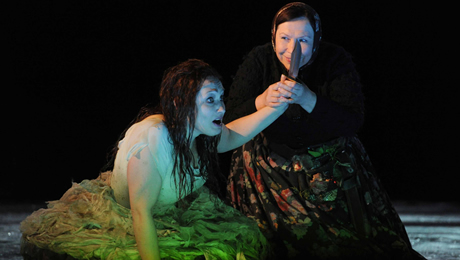
Antonin Dvorak: Rusalka
 

Wioletta Chodowicz Rusalka
Mischa Schelomianski Vodnik
Anne Mason Jezibaba

Ladislav Elgr Prince
Tatiana Pavlovskaya
Foreign Princess
Glyndebourne on Tour Chorus & Orchestra
Jakub Hrusa
conductor

9 November 2012, Wimbledon Theatre, London
********
 

As with so many fairy tales, this is a grim story.  The water sprite Rusalka falls in love with a prince.  But if she is to win him she must enter the world of humans and lose the power of speech.  Warned that this will be disastrous she goes ahead and finds that the prince tires of his mute bride and is drawn to a foreign princess.  Rusalka returns to the water cursed but the prince now follows and all ends dismally.


The opera turns on the duality of the water sprite’s world and that of the humans on land.  Glyndebourne’s production, directed by Melly Still, sought to convey this through elaborate choreography of the water scenes using long serpent tails and movement actors.  A tad over-fussy, it also proved quite intrusive when poor Rusalka is being lifted, spun and pawed by choreographic assistants as she sings her Song to the Moon.  This most famous music in Dvorak’s favourite opera was very nicely done by Wioletta Chodowicz, integrating it into the scene rather than separating it as an artificial “show-stopper”.

The wedding scene clearly had a good concept but the central angled walkway became a health and safety disaster when water was inadvertently spilt on it.  How the killer-heeled princess failed to fall remains a mystery, but it brought unwanted elements of drama to the celebration.

Don't slip!
Vodnik was a powerfully malevolent presence throughout and held our sympathies as Rusalka is undone at her wedding by the foreign princess.  His appearance at the climax of Act 2 was the musical highlight of the night.
 
All in all a fine evening at Glyndebourne on Tour, though this was a production with its heart in the sodden depths of the lake, which meant that the underpinning love story was underplayed.  While the tale is dark, it is the power of this love that triggers the plot.  At no point in Act 1 did it ring true – a fatal flaw.