Monday, 23 July 2012

Review - Antonacci sets Berlioz ablaze at the Proms


Berlioz: The Trojans

Bryan Hymel tenor (Aeneas)
Fabio Capitanucci baritone, (Coroebus)
Anna Caterina Antonacci soprano (Cassandra)
Eva Maria Westbroek soprano (Dido)
Royal Opera Chorus
Orchestra of the Royal Opera House
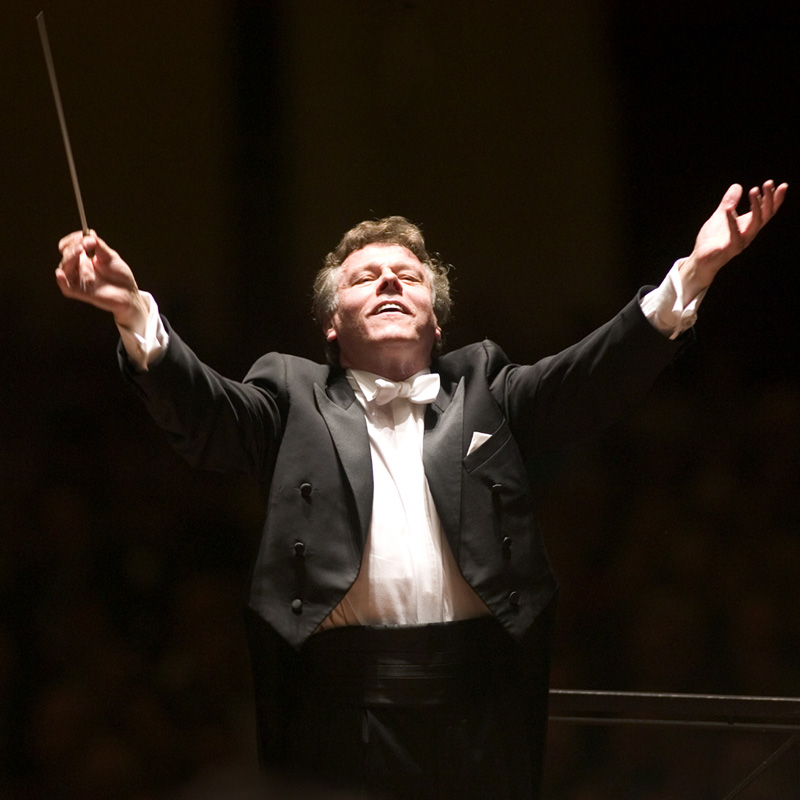
Sir Antonio Pappano conductor 

Royal Albert Hall, London, 22 July 2012
********************
Anna Caterina Antonacci as Cassandra (2003)
Berlioz described his opera The Trojans as "Virgil Shakespeareanised".  So the plot is based on Virgil's 1st century BCE poem Aeneid in which Aeneas escapes Troy as it is captured by the Greeks and goes on to found Rome after an extended dalliance at Carthage with its Queen Dido.  However the Shakespearean influence comes when Berlioz added elements drawn from his beloved Shakespeare such as Hector's ghost (modelled on Hamlet's father's ghost) and the interpolation of two comic Trojan sentries to undercut the pitiless tragedy of the final act.
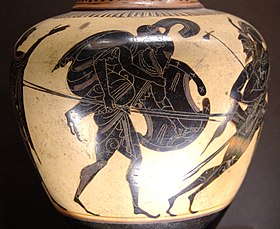
Aeneas carrying his father (c.520 BCE)
   

From this text Berlioz composed a 4 hour, 5 act opera focused on the sack of Troy (Acts 1-2) and the story of Dido and Aeneas at Carthage (Acts 3-5).  In the grand French manner, the opera encompasses massive chorus scenes, extended wordless ballet sections and the formal requirements of the opera of the time (arias, duets etc).   Berlioz seems to have been ambivalent about Aeneas' character and so greatly expands the role of Cassandra in Acts 1-2 who leads the drama, foretelling doom as the Trojans party and welcome the Greek's wooden horse into the city walls.  Cassandra acts therefore as a counter-weight to Dido in Acts 3-5.

Bryan Hymel as Aeneas at Covent Garden (2011)
The recent Proms appearances of Antonio Pappano and his Royal Opera House forces have been clear highlights among the musical cavalcade this biggest of musical festivals offers.  And last night's Prom was again memorable.  Delivering opera in an un-staged format at the Proms lost more than usual in the extended ballet scenes.  That said, the Royal Opera House orchestra, liberated from the dark opera pit, played with verve and beauty, and the chorus were tremendously dramatic.  It is the music that benefits from these evenings, and while we all know that some opera obsessives seem to like anything but music, for the rest these Proms are true luxury occasions.

Anna Caterina Antonacci launched the evening in blistering fashion with a Cassandra of enormous  passion and depth of characterisation.  Her range of tone and emotion were riveting - a great performance.  Bryn Hymel's Aeneas may not have conveyed much inner turmoil but was comfortably equal to the tremendous vocal demands of this gruelling part.  Eva Maria Westbroek took Dido on a powerful dramatic journey from her initial satisfaction at founding her new city, to the depths of despair as Aeneas cruelly deserts her.

Apologists for this opera tell its story as one of initial incomprehension, being routinely cut and performed in two separate halves, then finally emerging into the light in the landmark 1957 Covent Garden performance of the work in its entirety.  Personally, I wonder if Berlioz might have ultimately cut a solid half an hour of the 4 hour work, with Acts 3 and 4 in particular dragging.  Berlioz's music is a unique and marvellous thing - luminous one moment, spitting fire the next, the thrills are frequent.  But in Act 4, Dido and Aeneas really want to sing a love duet, but are cruelly delayed for a solid 10 minutes while a quintet and septet are worked through.  An excess of musical formality just gets in the way.  

Peter O'Byrne

Monday, 11 June 2012

Review - Pires casts her spell with Haitink's LSO

Purcell Chacony in G minor (arr. Britten)
Mozart Piano Concerto No 20, K466 in D Minor
Schubert Symphony No 9 in C (‘The Great’)

Bernard Haitink, conductor
Maria João Pires, piano
London Symphony Orchestra  

10 June 2012, Barbican Hall, London 
******************

Maria João Pires
Bernard Haitink directing this vastly enjoyable concert with his usual clarity and insight.  A short, sober Chaconny from Purcell via Benjamin Britten opened proceedings before the piano took centre-stage and with it the evening’s highlight: Maria João Pires.  In today’s age of over-hyped piano youths, Pires is a beacon of true musicianship.  Hers is an unflashy, quiet and calm genius.  She makes no attention grabbing gestures.  It is as if she is playing for the private pleasure of herself and her orchestral collaborators, and yet for the listener what she does is rich and deeply moving. 

Her style was all the more striking in a performance of perhaps Mozart’s most dramatic piano concerto - K466.  The orchestra’s opening is a masterpiece of minor-key unease, more lyrical moments interrupted by stormy clouds. Then the piano enters with disarming, plaintive phrases.  Pires took her cue from this poignant moment, never seeking to generate storms of her own, but drawing out the tensions in the interplay between the orchestra and the piano's lyricism. 
Throughout, the LSO woodwind provided some beautiful interplay with the soloist.

Pires never turned Mozart into a proto-Beethoven as some do and it was only in the notes that Beethoven did write – his cadenzas for this concerto – that her playing displayed some more pungent accents and flourishes.  Was it under-projected?  Definitely not.  It was entirely cogent and effective on its own terms.  The slow movement beautifully poised, and the Rondo finale brisk and dramatic.  Pires has achieved that consummation of artistry that replaces "art", in an artificial sense, with naturalness of expression.   She is perhaps an ideal Mozart pianist.  Haitink and the LSO certainly think so.  They play Mozart’s K488 concerto on Thursday and then play another two over a few days next February. 

After the interval, more delight came in the form of Schubert’s last symphony – Number 9 “The Great”.  This was vintage music-making from the Haitink-LSO team. Haitink emphasised the driven, military undertones of this piece, giving the timpani and brass some licence.   Occasionally there were enormous pauses.  Were we listening to Bruckner?  It was a nice effect, and Haitink is between Bruckner evenings in London (a 5th with the Concertgebouw Orchestra recently and the 7th on Thursday with the LSO).   At times, a little more space and Viennese charm would have been nice.  It is the central episode of the Scherzo that most calls for this, which with a Furtwangler becomes a golden moment.  I didn’t quite feel like getting up and dancing here.  But Haitink’s approach delivered its pay-off at the end of the last movement where the great pounding unison chords carried an extra charge of menace.  It was classic Haitink: the fruit of experience and a deep understanding of the work as a whole.   


Peter O'Byrne

Tuesday, 5 June 2012

Horse lost at Covent Garden

Verdi: Falstaff
Daniele Gatti, conductor
Ambrogio Maestri, Sir John Falstaff
Robert Carsen, director 
Royal Opera House Orchestra & Chorus

25 May 2012, Royal Opera House, Covent Garden, London
*************

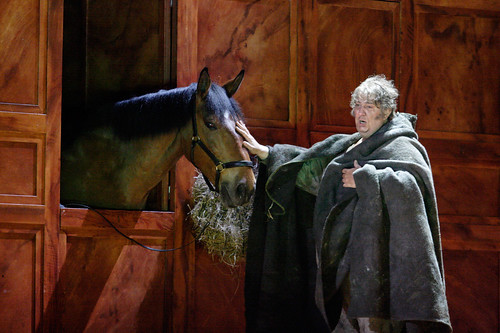
As Act 3 of Verdi's late comic masterpiece Falstaff begins, a horse looks onto a corpulent knight lying in hay outside an inn.   Slumped in the corner, Falstaff sings despondently about the state of the world and seeks solace from feeding the animal some hay.  In Robert Carsen's new production of the opera for Covent Garden it is an actual horse - credited as "Rupert" in the programme - that looks onto the scene.  Not quite elephants in Aida, but it produced a reaction from the audience.

Are such staging stunts worthwhile?  While the solid, nuanced Ambrogio Maestri as Falstaff delivered one of his big solo moments in a work dominated by ensemble, it was hard not to be distracted by the animal and whether it was going to fluff its stage directions.  At least here the observer from the animal kingdom helped to deepen the pathos of Falstaff's fall from grace (in this case literally - having been thrown into the street from the window above at the end of Act 2).

For Verdi's opera, Boito conflated Shakespeare's plays of The Merry Wives of Windsor and Henry IV, centring around the merry Knight's pursuit of two wealthy married women which results in much mockery.  Later on in the same Act, Falstaff enters singing while seated on the same horse.  Here the animal is entirely superfluous, a mere platform led on gingerly by 3 attendants and then led off never to be seen again.  Horses in various forms make other appearances in this production set in the 1950s, replete with wood-panelled rooms and formica kitchens.   George Stubbs' masterpiece Whistlejacket hangs on a wall amongst an otherwise lacklustre set of horse paintings.  Falstaff looks set for a fox hunt at various points of the evening.  However Rupert the horse looks merely lost, his involvement seemingly bolted on, rather than an integrated element in a new production.

But there was great pleasure to be had from the evening.  If it was not for Verdi (and Rameau) the summit of opera writing would be entirely Germanic.  But Verdi's orchestration in Falstaff was a surprise, not least in some quasi-Wagnerian brass writing.  The singers were strong and even, and the big comic moments delightful, led by the quartet of lunching ladies with their "Desperate Housewives" formica kitchens. And amongst it all Maestri was a majestic physical presence, bringing out the nobility of Falstaff underlying his comical excesses.

Peter O'Byrne


Thursday, 24 May 2012

Rapt Brahms from philosopher-virtuoso Volodos

Franz Schubert: Piano Sonata in A minor, D.784
Johannes Brahms: 3 Intermezzi, Op.117
Franz Liszt: Sonata in B minor
Arcadi Volodos piano

22 June 2012, Royal Festival Hall, London
***************

Anyone who has encountered the Sony recordings of Russian virtuoso Arcadi Volodos will know what an imposing musical personality he is.  But for London audiences he is only just starting to make regular appearances.  He started with a smooth and fluid Tchaikovsky First Piano Concerto in 2010 with the Leipzig Gewandhaus Orchestra at the Barbican.  However Tuesday's recital displayed the full range of his wares.  

Arcadi Volodos
The Schubert Sonata D784 is a bleakly beautiful piece and right from the start Volodos cast an immediate spell which only the most determined coughers in the audience could resist.  He is unafraid of playing quietly and slowly, inviting the listener to enter his sound world, slow to his heartbeat and philosophise with him. 

The Opus 117 Intermezzi proved the genial highlight of the recital - classic Autumnal Brahms.  Volodos took a very broad and introspective approach.  It might have dragged.  Instead it was riveting. What oceans of rich tone he conjured from the piano, even at low dynamic levels.   The instrument purred and glowed and Brahms' full textures were lovingly guided and piled up.  Masterly.

The Liszt Sonata would have benefited from a firmer grip on the overall arc of the work.  Volodos pulled the dynamics around a lot, disturbing the underlying pulse and emphasising its tendency to feel episodic.   But what pianism!  Volodos has the kind of dynamic range which most pianists can but dream of.   His bass chords could be massive fortissimo eruptions or hushed and ominous intrusions - evoking dusty, windswept grave-yards.  Even at pace and volume he never played through his tone.  There were no rough edges in this sound-world.

Want to know more about this highly individual and prodigious artist?  Look no further than his astonishing 2006 Liszt disc on Sony with the Vallee d'Obermann and his own arrangement of the 13th Hungarian Rhapsody.  Technically, Volodos is the rare type of pianist for whom the phrase "super-virtuoso" is made.  Combined with his intensely personal and original musical vision he is, at 40, a musical talent to follow with great interest.   

Peter O'Byrne

Friday, 18 May 2012

Mariss Jansons cancels conducting lecture

Leading conductor Mariss Jansons was due for a double of events at London's Barbican Centre last weekend.  On Saturday 12 May an all-Strauss concert with his Concertgebouw Orchestra Amsterdam, and on Sunday afternoon 13th a conducting lecture/masterclass.  

However, ill-health meant the interval at the Strauss was longer than normal and then at 10am on the Sunday those like me that were to attend the lecture received this email: 

"Thank you for booking tickets for the Mariss Jansons and Peter Blaha Conducting MasterClass at LSO St Luke's today at 3pm. Owing to the indisposition of Mariss Jansons it has been necessary, at very short notice, to cancel this event."

For those who know Janson's medical history, the word "indisposition" is certainly not code for "had a heavy night".  Jansons father, Arvids Janssons, died of a heart attack while conducting an orchestra and Mariss Jansons himself also had a heart attack back in 1997 while directing La Boheme.  Jansons is both the very greatest conductor before the musical public and the most fragile.  May he have a speedy return to health.

Saturday, 28 April 2012

Review - Solemnity and acclaim as Harnoncourt receives the  RPS Gold Medal

Beethoven Missa Solemnis, Opus 123

Royal Concertgebouw Orchestra of Amsterdam
Nikolaus Harnoncourt - conductor 
Marlis Petersen - soprano
Elisabeth - Kulman alto
Werner Güra - tenor
Gerald Finley - bass
Groot Omroepkoor (Dutch Radio Chorus)

22 April 2012, Barbican Hall, London
*****************

Nikolaus Harnoncourt
Conductor Nikolaus Harnoncourt is a rare visitor to London, so the prospect of him directing Beethoven's epic Missa Solemnis with that Rolls Royce of orchestras - the Concertgebouw - was mouth-watering.  And it was a high-fibre audience that attended.  In my immediate vicinity at the Barbican were the directors of the Proms Festival and the Barbican Centre and the conductor Semyon Bychkov.

An ideas man, Harnoncourt was sure to be at his best in a work teeming with ideas.  Beethoven famously deploys military march interjections in the concluding Agnus Dei to undercut the prayer for peace in the mass text. However it was with an aura of calm that the performance was conducted.  With reverence and clarity, Harnoncourt directed his forces.  Not for him the excitable gear changes of others in this massive composition that Beethoven composed over 5 years towards the end of his life.  Originally intended for the enthronement of his patron Archduke Rudolph in 1820, Beethoven did not finish the work until 1823 and at 80+ minutes it reaches far beyond any practical liturgical purpose.

Not that it was leaden: the underlying dance rhythms were brought out, the Sanctus flowed smoothly and the Agnus Dei was as intense and draining as it should be.  Harnoncourt's vision was supported to the hilt by his very fine musicians: the Concertgebouw Orchestra was supple and refined, the Dutch chorus did not flag in a taxing work, and the soloists kept the histrionics to a minimum, producing a beautifully blended sound as a quartet.  Elisabeth Kulman's mezzo was nicely dark and withdrawn, while Gerald Finley's baritone entry in the Agnus Dei worked hard to not stand out too much from the chorus directly behind him. 

This was commmunal music making of a high standard and it was fitting that this preceded the presentation that followed.  At the end John Gilhooly (director of Wigmore Hall and President of the Royal Philharmonic Society) presented Harnoncourt with the RPS Gold Medal.  This must surely be one of the 2 or 3 most revered prizes for a musician.  It has been awarded since 1870 to commemorate Beethoven's birth in 1770 and its recipients are most exalted: Brahms, Richard Strauss, Elgar, Stravinsky, Bernstein and current leading musicians including Barenboim, Domingo and Boulez.  Harnoncourt's career leading the period performance movement and then transferring much of that skill to modern as well as period instrument orchestras places him centrally in the development of orchestral performance since the 1960s.

Harnoncourt's speech was a model: paying tribute to the composers without whom he could do nothing "for I cannot write a note!", he then accepted the award on behalf of all the musicians he has worked with for 60+ years because "without them I am but dust".

Tuesday, 24 April 2012

Review - Berliner Staatskapelle and Barenboim triumphantly conclude Bruckner week

Wolfgang Amadeus Mozart: Piano Concerto No.22 in E flat, K.482
Anton Bruckner: Symphony No.9

Staatskapelle Berlin
Daniel Barenboim conductor

20 April 2012, Royal Festival Hall, London
********************

Daniel Barenboim and the Staatskapelle Berlin brought their week long residency to a close with the last and most awe inspiring of the lot - Bruckner's 9th Symphony - and a well deserved ovation.
Barenboim in (much) earlier days

They first brought great style and poise to Mozart's 22nd Piano Concerto.  Easily one of Mozart's best concertos, it contains unusual lyrical interludes for the woodwinds where the Staatskapelle players shone.  Barenboim's playing was equal to his orchestra - affectionate, spontaneous and revelling in the contrasts of the score.
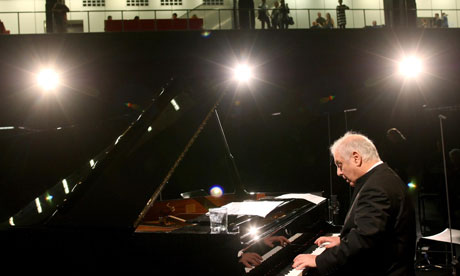
...and in 2011
Barenboim chose some daringly spacious speeds for the Bruckner 9th.  The 9th remains incomplete with the fourth movement finale not finished at his death, but its 3 completed movements still make it perhaps the most far-reaching and profound of Bruckner's works.  The Staatskapelle were in fine form again in maintaining the line and tension, and produced richly satisfying Brucknerian climaxes.  The scherzo was tight, sinister and detailed.  The blazingly dissonant chord that marks the peak of the adagio was a perfect musical moment: punched out with all parts of the orchestra marvellously blended from the timpani through brass and woodwind to the strings.  Barenboim added his bit by extending the time the chord is held.  It was shattering, and its memory the perfect backdrop for the concluding pages.

This was a special concert to close a great Brucknerian week in London.  The appeal was multi-faceted: the poetic gift of Mozart, the cosmic ambition of Bruckner's 9th, the close partnership of the Staatskapelle Berlin and their chief conductor, and Barenboim's own personal connection with the London musical public.