Showing posts with label Barbican. Show all posts

Saturday, 7 December 2019

Dvorak and Beethoven from the Hungarians

Dvořák Legends, Op 59 No 5; Ukolebavka (lullaby) from Four Choruses, Op 29 No 2; Slavonic Dance, Op 72 No 8 
Beethoven Piano Concerto No 5
Dvořák Symphony No 8
Budapest Festival Orchestra
Iván Fischer, conductor
Sir András Schiff, piano
Barbican Hall, London, 30 November 2019
*************
The Budapest Festival Orchestra never fail to delight, and under the inspired directorship of Ivan Fischer, this proved the case again.  With 6 double bases arrayed at the back, the string sound gleamed supported by rich tonal depth during the opening Dvorak Legend. 

There is nothing this orchestra can't do, so they then stood and delivered an excellent a capella rendition of a Dvorak lullaby for chorus.  Sensitive, balanced and a perfect contrast, and yet another example of the Budapest players' capacity to deftly enliven the traditional classical concert.

Joined by the ultra authoritative musicianship of András Schiff, the Beethoven Emperor Piano Concerto sounded as fresh as the day it was written.  The orchestra continued it's plush sound while Schiff consistently brought out the harmonic writing to surprise the ear.  How simple Schiff made other soloists sound with only eyes for the right hand melody.  The outer movements were thrilling in their structural command and the clarity of his vision.  Although no single approach can encompass this work, and perhaps in the slow movement Schiff's more prosaic approach missed that last ounce of poetry.

Schiff has become more of a cult figure with every year, and he treated us to an extended encore - the first movement of Beethoven's Waldstein Sonata no less - with the repeats.  Rhythmically electrifying and a little showy in its "look at me" internal highlighting.  But it was an encore after all.

Finally the sunny Dvorak 8th Symphony.  It is an episodic work compared to the 7th or 9th, but what episodes.  The Budapest orchestra savoured every one with great care and the flute and oboe contributions were particularly delicious.  The brass get their way at the end but this orchestra always plays with exemplary balance, so it was a triumph with their fellow players.  Long may this orchestra continue.

Saturday, 16 March 2019

Arcadi Volodos plays it quiet

Schubert Piano Sonata in E major, D157
Schubert Six moments musicaux, D780
Rachmaninov Prelude in C-sharp minor, Op 3 No 2
Rachmaninov Prelude in G-flat major, Op 23 No 10
Rachmaninov Prelude in B minor, Op 32 No 10
Rachmaninov Zdes'Khorosho, Romance Op 21 No 7 (arr Volodos)
Rachmaninov Serenade, Op 3 No 5
Rachmaninov Etude tableau in C minor, Op 33 No 3
Scriabin Mazurka, Op 25 No 3
Scriabin Caresse dansée, Op 57 No 2
Scriabin Enigme, Op 52 No 2
Scriabin Flammes sombres, Op 73 No 2
Scriabin Guirlandes, Op 73 No 1
Scriabin Vers la flamme, Op 72

Arcadi Volodos piano

Barbican Hall, London, 7 March 2019
******************

As a pianist, Arcadi Volodos, is very much sui generis. His pianism of such quality that it is a wonder in itself, as much for its poetic as technical capacity.

He performed the early incomplete D157 Sonata of Schubert with enormous care and a kind of radiant inwardness which made a maximum case for this sonata.  Most memorable was the hypnotic Andante.  Then began what must be one of the slowest performances of the Moments Musicaux in London recital history.  These are magical pieces, and Volodos' willingness to truly play piano was admirable.  But the effect was ever so slightly soporific.

The sequence of Rachmaninov preludes may have been expected to change the tone, but no.  Reflective, exquisitely weighted performances continued.  The B Minor Prelude Op 32/10 could have been written for Volodos' special qualities.  His velvet touch and deep musicianship turned its 5 minutes into a searching, epic experience.  But was not some drama missing?

Scriabin's miniatures are as important as Rachmaninov's to the piano repertoire and here Volodos' apparently limitless palate of colours and intonation spoke authentically.  There is always a question of how to shape these pieces.  Are they short, incomplete statements, or rounded coherent journeys? Volodos gave us supple pianism, but favoured the moment over the whole.

All of which led us to the inexhaustible mysteries of Vers la flamme (Towards the flame).  In many ways the culmination of Scriabin's mystical beliefs, the build towards the flames of destruction (of music? of the world?) was compelling as Scriabin's roulades of tremolos and harmonies rounded off the advertised programme.

This recital certainly did not catch fire.  However it was a fine meditative experience, eavesdropping on a pianist producing magical sounds, while stuck in a slow inward mode throughout.

Arcadi Volodos


Sunday, 8 April 2018

Evgeny Kissin hammers the Hammerklavier

Beethoven Sonata No 29 in B flat Hammerklavier

Friday, 16 February 2018

Argerich, Maisky and Jansen at the Barbican

Saturday, 25 November 2017

Rattle champions Haydn

Wagner Prelude and Liebestod from Tristan and Isolde
Bartok Piano Concerto No. 2
Haydn An imaginary orchestral journey

London Symphony Orchestra
Denis Kozhukhin, piano
Simon Rattle, conductor

Barbican Hall, London 11 July 2017
****************
Simon Rattle’s commitment to Haydn’s genius produced a memorable Barbican night.  For him this was a reprise of a concert in Berlin stringing together movements from various Haydn works into “An Imaginary Orchestral Journey”.  This type of thing has also been successfully done to Rameau by Marc Minkowski.
The Esterhazy Palace, Haydn's long-term home


As well as giving a more prominent platform for part of the “7 Last Words of Christ”, Symphonies 64, 6, 46, 60, 45, and 90 were excerpted as well as The Creation, The Seasons and the obscure L'Isola Disabitata. There was some lovely moments of fantasy, not least when the little known mechanical organ took centre stage.  Haydn wrote 17 pieces for mechanical organs, one of which was featured here before Rattle paused proceedings to listen to these little constructions being broadcast unadulterated from various locations around the Barbican Hall. Somehow both arch and evocative all at the same time.
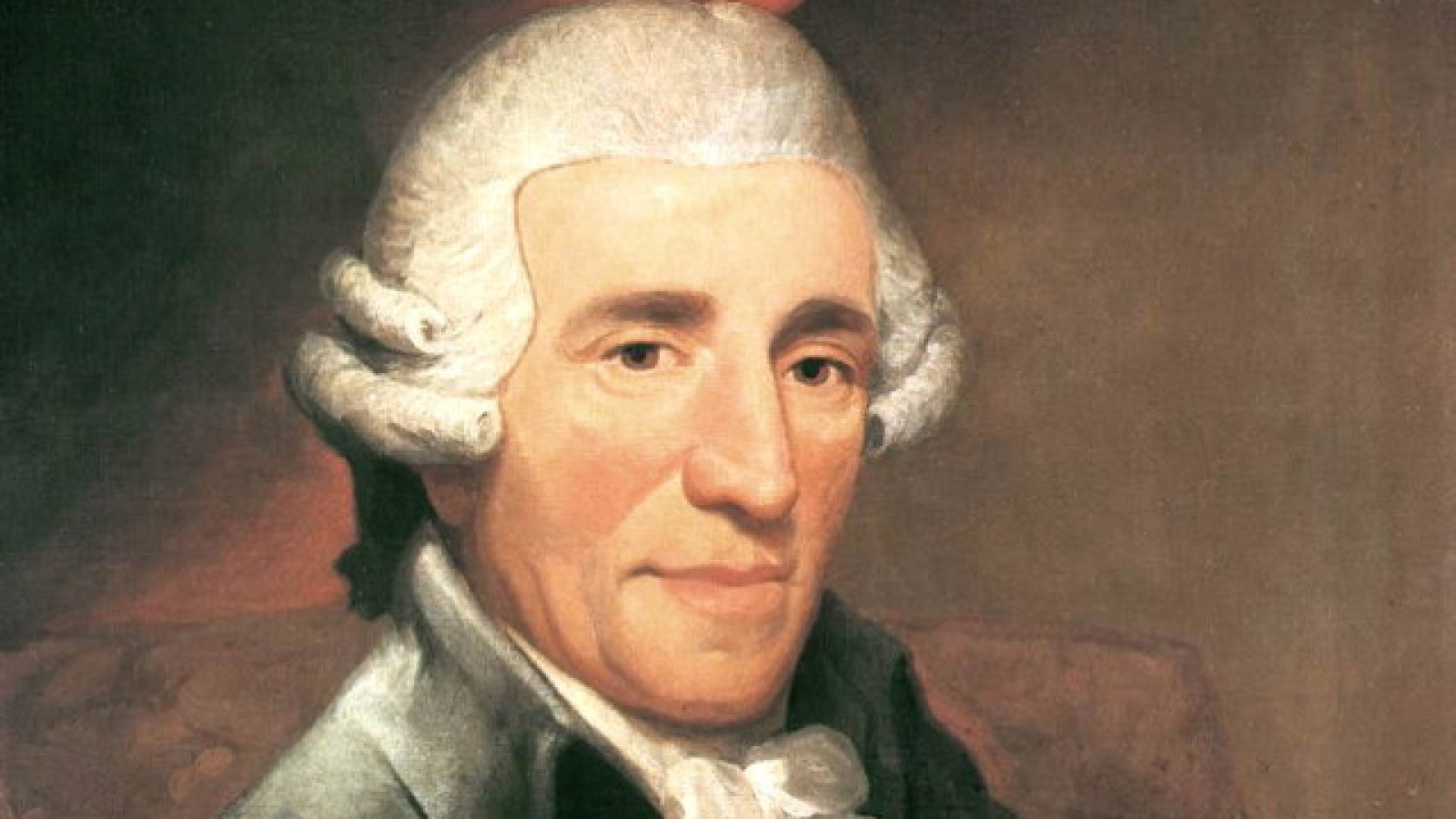
Joseph Haydn


Saturday, 25 February 2017

Jonas Kaufmann's Die Walküre

Richard Wagner
Prelude to Tristan und Isolde
Wesendock
Lieder
Act I from Die Walküre 

Jonas Kaufmann tenor
London Symphony Orchestra
Jonas Kaufmann
Antonio Pappano conductor
Karita Mattila soprano
Eric Halfvarson bass

Barbican Hall, London, 8 February 2017
*******************

Jonas Kaufmann's Barbican residency across 4 concerts continued with a much-anticipated Wagner evening.  And it was inevitably the Walkure First Act that dominated proceedings. 

For this he was joined by the no less formidable Karita Mattila as well as Pappano leading the LSO.  The LSO threw us into a most vivid storm after which we heard Kaufmannn's Siegmund emerge.  This was sophisticated Wagner, marked by an intensely lyrical line.  How glorious to hear the role properly sung, rather than shouted.  Wintersturme never sounded more beautiful.

The down-side was that a truly heroic impact was missing from the closing pages of this wonderful slow-burner of an Act. For some true Wagnerian abandon one had to turn to Mattila.  She was less in control, more squally, but delivered an authentic emotional punch.  Standing next to her, both in physical and vocal gesture, Kaufmann gave the impression of pacing himself and guarding his voice for the concerts to come.  That said, the cries of Walse, Walse were thrillingly sustained.

For the evening's complete performance Eric Halfvarson's Hunding was surely as close to ideal as it is possible to hope for.  From cracking bottom notes to physical menace he dominated everything he did.  Not even the weird placement of Pappano directly between him and the other two soloists could spoil the dramatic effect.

Pappano may not be a master of the long line, but the LSO built up a great head of steam in the exhilarating conclusion. Could someone not have set up the singers a more comfortable distance from his podium and those arms so frequently whirling like windmills?   In the first half, the Tristan Prelude did not catch fire but the Wesendonk Lieder again showed off the fine, lyrical beauty of Kaufmann's sophisticated tenor voice.  

Karita Mattila


Tuesday, 22 November 2016

Bartoli cancels Barbican recital

Cecilia Bartoli was to have been performing at the Barbican this Friday in an all Handel evening.  However today it was annnounced this would be cancelled:
'We regret that Cecilia Bartoli is suffering from a very heavy cold, and is deeply sorry that she has to cancel this concert.'

Cecilia Bartoli

Monday, 25 January 2016

Francois-Xavier Roth conducts Wagner, Berg, Mahler

Richard Wagner  Prelude to Act 1, Parsifal
Alban Berg  Seven Early Songs
Gustav Mahler  Symphony No. 5
 
London Symphony Orchestra
Camilla Tilling soprano
Francois-Xavier Roth conductor

Barbican Hall, London 21 January 2016

**************** 

"After Romanticism" was the title of the concert, and certainly in the resonance-free acoustic of London's Barbican Hall, Parsifal had never sounded so abstract and modern.  Wagner's long musical lines of religious mysticism stepped abruptly into silence.  Not for the first time the excellence of the LSO strings was striking. 
Francois-Xavier Roth

Berg followed, the words vividly interpreted by soprano Camilla Tilling even if she rarely projected her voice far into the hall.  And then to Mahler after the interval.  Roth writes of this period of the end of the 19th and start of 20th centuries fascinating him and throughout this reading he seemed intent on emphasising the strangeness of Mahler's new sound world.  Written in 1901-2 this sprawling masterwork baffled contemporaries and Roth was inviting us back into that jarring first encounter.  

Organic dimensions were recessed and the sheer weirdness of the orchestration at for example the close of the second movement, was striking.  This is a personal favourite amongst Mahler's uneven symphonic output, but I found myself with sacrilegious thoughts.  Surely 10 minutes could be cut from the Scherzo and not be missed?  Does the finale really work, and doesn't it also carry a lot of fat?  

At the crucial adagietto, it was all a bit calculating for this love poem.  At the climax Roth's baton-less hands flailed at the air, part Stokowski, part claws.  It was a visual counterpart to a moment that wanted a more delicate approach. 

So a night of mixed results.  But Roth is clearly a conductor of strong ideas, and with the LSO strings on majestic form this night will linger in the mind.

Friday, 14 November 2014

Siberian bear tames Barbican

BALAKIREV Russia
RACHMANINOV Piano Concerto No 2
RACHMANINOV Symphony No 3


Valery Gergiev conductor
Denis Matsuev piano
London Symphony Orchestra


Barbican Hall, London, 13 N0vember 2014

***************

'The Siberian bear with the fastest paws in the Arctic and perhaps anywhere else'.  This is the quote Denis Matsuev's publicity used in advance of the night.  It's the kind of circus copy that Debussy lampooned:

"The attraction of the virtuoso for the public is very like that of the circus for the crowd. There is always a hope that something dangerous may happen: Mr. X may play the violin with Mr. Y on his shoulders; or Mr. Z may conclude his piece by lifting the piano with his teeth."

Matsuev does not need it really because his partnership with Valery Gergiev and the London Symphony Orchestra in Rachmaninov's 2nd Piano Concerto was exceptional.   Matsuev was in total command, his style virile and assertive, but the weighting also well graduated. 
His tone is big and what a pleasure to hear the piano part rippling with such muscularity against the orchestra at full volume.  The interpretation felt totally authentic and committed, and the LSO responded with warmth and virtuosity. 

The whole thing was an unalloyed joy.  A performance well in the Argerich or, dare this blog say it, Richter category.  He received tumultuous applause afterwards, which was rewarded with a very expansive Rachmaninov A minor Etude-Tableau Opus 39/2.

This was framed by a potpourri of Russian themes from Balakirev, and the late Third Symphony of Rachmaninov.  Was it that it was heard during the aftershock of Matsuev, or is this late statement from a tiring composer simply not very good?

Wednesday, 5 November 2014

Mariinsky Opera perform Boris Godunov original version

Mussorgsky Boris Godunov
Concert performance

Mariinsky Opera
Valery Gergiev conductor
Mussorgsky's gravestone, Tikhvin Cemetery

Mikhail Kazakov Boris Godunov
Mikhail Petrenko Pimen
Evgeny Akimov Prince Shuisky
Alexei Markov Shchelkalov
Andrei Popov Simpleton
Tiffin Boys Choir

Barbican Hall, London, 3 November 2014

*******************

This, the most Russian of all operas, was premiered at the Mariinsky Theatre in 1874.  And now it was the Mariinsky Opera under the direction of Valery Gergiev that performed it as part of their Barbican residency. 
Boris Godunov

Boris Godunov was Tsar of Russia from 1598 - 1605, having been a counsellor under the equally famous Ivan the Terrible.  His reign was overshadowed by the rise of a pretender to the throne and dark rumours of the Tsar having murdered one of Ivan's sons.  Alexander Pushkin wrote a tragedy Boris Godunov which Mussorgsky adopted for his opera. Mussorgsky penned the libretto himself and it is an extended examination of the soul of Russia, brimming with suffering and resignation.  Its troubled commentator is the Simpleton, who mourns Russia's sorrow and its entry into a "long dark night".

Mussorgsky first took up the idea in 1868 and after a tortuous 6 years of working and re-working it was finalised and premiered.  The reception was ecstatic, with the composer reportedly taking 18 curtain calls from the packed Mariinsky Theatre.  The tangled history of the opera's composition has left many different versions in existence with some scenes regularly cut or re-ordered, and that is without even talking about Rimsky-Korsakov's controversial "improvement" of the orchestration.

It was the original 1869 version that the Mariinsky brought to the concert.  This was the version Mussorgsky submitted to the Russian censors, who then demanded changes (notable that a dramatic soprano role be included) prior to its 1874 premiere.  Inevitably in a concert performance the absence of staging was more keenly felt in the theatrical crowd scenes than the dialogues and monologue elsewhere.  Even so, the stage set up could easily have been better, with the singers having to contend with a forest of 10 seats and music stands, most of which were simply not required. Some, such as Kazakov, fully acted out their role around the stands.  Others, slightly bizarrely, stuck to their music as if in an oratorio.

At the very opening of the opera and his coronation as Tsar, Boris is beset by
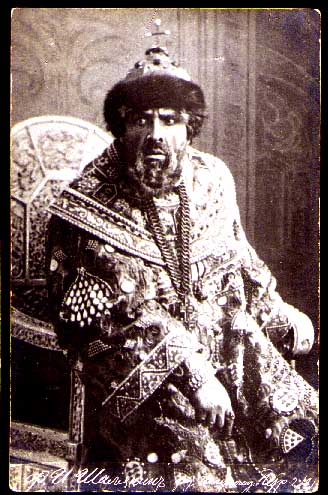
Bass Feodor Chaliapin as Boris Godunov
the knowledge of his guilt.  This intensely psychological figure is one of the finest tragic characters in opera and undoubtedly the greatest of all Russian bass roles.  Here the challenge was taken on by Mikhail Kazakov who was at pains to really sing the role, emphasising its lyrical dimension as well as weight and emotion.  Only in the heroic moments such as the Coronation scene was the relatively light weight of the voice a limitation.  Kazakov‘s Boris was keen to behave well as a ruler despite his guilt, and was profoundly concerned that his children not bear responsibility for his crimes.

Around the central character are arrayed various classic Russian types: the holy monk Pimen, and the holy fool Simpleton who bears obvious similarities to characters such as Prince Myshkin in Dostoevsky's The Idiot.  Most important of all are the chorus representing the long-suffering Russian people.

Of the other roles, the Pimen of Mikhail Petrenko and the Simpleton of Andrey Popov were both near ideal.  Petrenko had a very natural weight and nobility and brought a subtle light and shade that enlivened the long narrations in the second and fourth acts.  Popov created a memorable intensity of atmosphere in the scene with Boris outside St Basil’s cathedral.  The chorus were idiomatic and committed throughout as would be expected.


The Mariinsky Orchestra were the solid base of this performance.  Their body language suggested they were less than thrilled about the evening, but there was nothing half-hearted about the music-making.  Valery Gergiev looked similarly disinterested, but his conducting was superb, particularly noticeable in his masterly pacing of the Prologue.


With the awkward stage-management, the performance was always on the back foot in creating and maintaining atmosphere.  It was thus all the greater testament to the contributions of Kazakov, Popov and the chorus in particular that so much of this evening was so electric.


Boris Godunov as it wasn't at the Barbican.  Here a scene from the Mariinsky Theatre - the stage production by legendary Russian film director Andrei Tarkovsky


Thursday, 10 April 2014

Bruckner Ninth from the Concertgebouw Orchestra

Beethoven Piano Concerto No 1 (1800)
Bruckner Symphony No 9 (1896)

Royal Concertgebouw Orchestra Amsterdam
Mariss Jansons
conductor
Lars Vogt piano


Barbican Hall, London, 5 April 2014
*****************
The final concert of the Jansons/Concertgebouw Orchestra 3 day residency at the Barbican started with Beethoven's perennnially fresh First Piano Concerto.  At the piano was the thoughtful, refined and impish pianism of Lars Vogt.  As with the other nights the soloist was beyond reproach.  Vogt had particular fun projecting the Beethovenian humour in the first movement coda: teasing the audience with when it was going to end, and striving for maximum surprise when Beethoven throws out fortissimo chords after quiet interludes.  The Concertgebouw Orchestra were again attentive and cultured partners, with anything that the clarinet or oboe touched turning to musical gold.

And so the visit concluded with the last Bruckner symphony - the mighty, unfinished 9th.   What a composition this is and how very worthy a successor of that other D Minor work - the Beethoven Ninth Symphony.  The Barbican crowd was expectant– not least Jansons’ wife and the Concertgebouw Orchestra’s manager seated next to me.  

This was again a performance of exalted technical quality and Jansons’ usual attention to detail.  Speeds were brisk, and in the Scherzo there was some bizarre handling of tempo at the start which slowed up for the pounding bass notes, before regaining the original tempo as the first violins re-entered.  It was obviously prepared as such, but why?  The great Adagio developed to a massive climax and the final closing notes were wonderfully sustained by strings and brass.  What a sound the Concertgebouw Orchestra produce when on their game.

Mariss Jansons
This Bruckner residency never fell below the very high standards to be expected from the Jansons/Concertgebouw dream-team.  Jansons approach was beautifully crafted and detailed.  The sheer beauty of sound on offer will not be easily forgotten.  Ultimately that this was not a revelatory experience comes down to Jansons not being the most natural of Brucknerians.  Movements did not accumulate like they do at their best, tempi were a little too forced to allow maximum expression, and the structural sense was not as assured as that of a Skrowaczewski.   
 
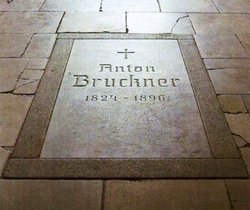
Bruckner's gravestone


The applause at the end from the Barbican audience after the Bruckner was long and enthusiastic, but stopped short of a standing ovation.  Probably about right.   In the end it was the concerti that struck one as closer to ideal.  Thinking back over the three partnerships with Lars Vogt, Truls Mork and Frank Peter Zimmermann, I wouldn’t change a single aspect of any of them.


Sunday, 6 April 2014

Haydn overshadows Bruckner

Haydn Cello Concerto in C (1765)
Bruckner Symphony No 7 (1883)

Royal Concertgebouw Orchestra Amsterdam
Mariss Jansons
conductor
Truls Mørk cello


Barbican Hall, London, 4 April 2014
****************
The residency of the Royal Concertgebouw Orchestra at the Barbican continued with the Bruckner Seventh Symphony.  Before that we were again treated to an immaculately presented classical concerto.  Tonight the Haydn C Major Cello Concerto.  Truls Mork was an ideal soloist, pure toned and elegant.  The easy rapport with the Dutch orchestra was again plain, and the whole performance projected a pleasing sense of joy in this delightful music.

With the Bruckner results were more uneven.  I had high hopes that the eloquence of the Concertgebouw strings would thrive in this most lyrical of Bruckner symphonies.  In the end, some of the shortcomings that were minor blots on the previous evening were now more troublesome.  The opening movement was rather brisk, and never allowed to breath naturally or achieve its full measure of grandeur.  Individual sections were carefully shaped but the whole never cohered.  By contrast, the great Adagio was thrilling, driven by the utterly glorious sound of the Concertgebouw Orchestra.  The strings were particularly impassioned and the famous climax (complete with triangle) was beautifully shaped.  Jansons again revealed himself unafraid of the pastoral interludes in the Scherzo which were lovingly done.  However the Finale never gained traction.  It is, of course, one of Bruckner's least successful movements, but the feeling that the wood had been lost for the trees was strong.


The Royal Concertgebouw Orchestra at home in the Concertgebouw main hall in Amsterdam.

Saturday, 5 April 2014

Jansons' Bruckner residency at the Barbican

Mozart Violin Concerto in G major (1775)
Bruckner Symphony No 4 in E flat (1880)


Royal Concertgebouw Orchestra Amsterdam
Mariss Jansons
conductor
Frank Peter Zimmermann violin


Barbican Hall, London, 3 April 2014

****************
Anton Bruckner
The great Mariss Jansons is best known for his interpretations of composers like Sibelius, Dvorak, Mahler, Tchaikovsky, Shostakovich and Beethoven.  However in recent years he has increased his attention for Austrian composer Anton Bruckner.  Was it his brush with death 18 years ago that triggered this, when he had a heart attack on the podium conducting La Boheme?  Whatever the case, this most spiritual of composers was front and centre for the 3 concert residency of Jansons and his Royal Concertgebouw Orchestra at London's Barbican. Each night, the great symphonies 4, 7 and 9 were leavened by 3 classical concerti of Mozart, Haydn and Beethoven.

Having Frank Peter Zimmerman, Jansons and this wonder-orchestra lavishing such attention on one of Mozart's lesser moments was certainly an indulgence.  But when the performance was so graceful, relaxed and poised, it came to seem a blessing rather than a waste.  Zimmerman was equally refined and intimate in his Bach encore.

The Bruckner Fourth Symphony so strongly evokes  German romantic moments set in forests and valleys, one can understand why a descriptive programme circulated on its release referencing hunting scenes, knight processions, medieval worlds...  Its opening must be one of music's most famous - a distant horn sounding across the musical landscape.

But that start was not auspicious.  The first horn splitting several notes only bars in.  Was it the ultra-dry Barbican Hall that unsettled him?  Bruckner wanted his symphonies played in cathedrals with their long reverberations.  Acoustically, the Barbican is a kind of anti-Bruckner hall. Whatever the case, the orchestra seemed to be slightly tentative and adjusting to the sound of the hall in the first movement.  

With the second movement the sound changed entirely: more blended, filling the hall more naturally.  In this movement, the nocturnal funeral march, almost imperceptibly Jansons drew us in until something at once beautiful and disquieting was in control.  This was his genius to draw out not only the village-pastoral simplicity of the dance motifs (here truly enjoyed) but also the ghostly, spirit-inhabited underworld of the Austrian forests of legend.  

Jansons' Bruckner starts off on the human scale.  His best moments were frequently bringing out the simple, village delights.  But this Andante brought an authentic sense of unease.  Its pastoral spirituality encountered the numinous but also the unknown, malevolent spirits of the mythic forest world, where humans can be tempted and brought undone.  It was classic Jansons: drawing out and making plain the logic, beauty and power of the "lesser" internal moments of the big symphonies.

The Scherzo was then on the surface the world of hunting calls, but also carrying a disturbing quality.  Jansons was totally at ease in the contrasting trio; bucolic and exuberant.  His Bruckner is not "cosmic", gazing down from the planets.  He embraces the pastoral v spiritual contrasts in the music but also attempts to make their rhetorical register not too far apart.

The great struggle to find a conclusion which is the last movement then carried extra weight of meaning after the darker experiences of those internal movements.  And this was Bruckner, so all of the previous 60 minutes then emptied into the great final coda, here quite electrifying.  The whole unfolding darkly, as if (as Jansons said in a recent interview) “God was wagging his figure at the the world. He was saying ‘you better be careful, you will be penalised if you continue in that direction’”.   Here the orchestra sound was at its finest: eloquent, rounded, the woodwind and brass playing through the string sound.  These Bruckner codas are some of the finest music on earth, and this performance entirely worthy of it.

Friday, 22 November 2013

Barbican audience eavesdrop on LSO rehearsal

Berlioz Romeo and Juliet

Olga Borodina mezzo-soprano
Kenneth Tarver tenor
Evgeny Nikitin bass-baritone
London Symphony Chorus
London Symphony Orchestra

Valery Gergiev conductor


13 November 2013, Barbican Hall, London
************

Valery Gergiev is taking his London Symphony Orchestra for another dash through a chunk of repertoire.  This time it's Berlioz for the Gergievation, with over three nights reeling off concerts featuring Harold in Italy, Romeo et Juliette and the Symphonie Fantastique respectively.

Valery Gergiev
No, wait.  It's better than that.  Try this for an early November all-Berlioz schedule:
6th: Romeo and Juliet at London's Barbican
7th: The Damnation of Faust at Barbican
8th: Symphonie Fantastique at Brno, Czech Republic
9th: Symphonie Fantastique at St Poelten, Austria
10th: Symphonie Fantastique at Essen, Germany
11th: rest day (phew!)
12th: Harold in Italy at Barbican
13th: Romeo and Juliet again at Barbican
14th: Symphonie Fantastique at Barbican
15th: rest day
16th: Symphonie Fantastique in Paris
17th: Romeo and Juliet in Paris

Does this make for good music making?  Maybe by the time they get to Paris on the evidence of this performance.  I was trying them out with the second performance of Berlioz's magnificent Romeo and Juliet at the Barbican.  As is well known, Berlioz adored Shakespeare.  His response to Romeo and Juliet was as original as it was successful.  He called it a symphony and it is the central orchestral movements that carry the main weight fo protraying the play.  Feeling it pointless to try and set chunks of dialogue to music he framed the work in a vocal prologue and finale for chorus and two soloists.

Having recently heard Beethovenian Brahms now it was the turn to hear Berlioz under the Beethoven influence.  And what great writing this is.  Successive orchestral sections on the Capulet Ball, Balcony Scene, Queen Mab, Juliet's Funeral Convoy and finally Romeo at the Capulet's Tomb.


Olga Borodina
Olga Borodina left one wanting more of her luxury voice and Kenneth Tarver handled  his Queen Mab solo with an ideal feather-light touch.  Evgeny Nikitin by contrast sounded a little out of his comfort zone but the choruses were generally excellent.

With the stage draped in microphones for the planned disc from these concerts, was Gergiev's attitude to balance more thinking of the recording than the live performance?  At the gorgeous bursting forth as the small chorus describes the Balcony Scene in the Prologue, the orchestra completely swamped the voices.  A major failing for those of us in the hall, but easily fixed at the mixing desk later. 

What a curious evening's music making this was.  Gergiev's legendary grip only revealed itself in a riveting performance of Juliet's Funeral Convoy.  But for the most part it felt tentative; part final rehearsal, part public concert, part studio recording session.  How Chailly's recent super-prepared Brahms contrasted with this work-in-progress Berlioz.  

Saturday, 2 November 2013

Kavakos and Chailly bring rapturous close to Gewandhausorchester residency

Brahms Violin Concerto in D, Op. 77
Brahms Symphony No 4 in E Minor, Op. 98

Gewandhausorchester Leipzig
Riccardo Chailly
conductor 

Leonidas Kavakos violin

30 October 2013, Barbican Hall, London
*************

The four concert Brahms cycle presented by Ricardo Chailly and his Leipzig Gewandhaus Orchestra over the last week concluded on Wednesday with the same exalted levels of musicianship as the previous evenings.

Which is the greatest romantic violin concerto?  Well the Brahms sits at the top or high on anyone's list.  From simple opening to thrilling acceleration into the march rhythm coda in the finale, this concerto rather tends to knock all comers for six. How would Leonidas Kavakos fare after his patchy participation in last week's Double Concerto? 
Leonidas Kavakos

Well, it was happily an experience of an entirely different order. The Gewandhausorchester opened the concerto with quiet simplicity and a very broad tempo.  From his first entry Kavakos was precise and hyper-sensitive to his every note and Chailly the most intensely collaborative of conductors. This culminated in a daringly broad but completely riveting cadenza of the first movement, delivered to a raptly silent Barbican.  The orchestra re-entered rolling out the most fabulous of sonic magic carpets while Kavakos' violin soared over the top.  Perfection.

The Andante that followed reminded us that other great soloists were in the hall.  The Gewandhausorchester's principal oboe, not for the first time during this Barbican residency,  opened with a ridiculously creamy solo.  It was something of a disappointment when the violin had to take over the melody.  The entire woodwind section of the Gewandhausorchester play with a distinctive group sound: rich, even plummy, and with a heightened expressiveness that constantly brings to mind the human voice.

And we should have known that anyone who, like Kavakos, has played Paganini's own 18th century Guarneri violin (nicknamed "Il Cannone"!), would be in touch with his demonic side.  The Allegro finale abounded in gypsy abandon and thrilled to the end.  Together with Volodos the previous week, this Brahms cycle has featured two soloists in the very top bracket.

After we had recovered during the interval, these Leipzig evenings concluded with Brahms' most taught and tense symphony - the Fourth.  Not one to loiter to long over an interlude, Chailly's directness brought huge emotional drive to the first movement's climax with the french horns implacable.  By contrast, the famous flute solo in the Allegro energico was intensely expressive, indeed delivered in a flexible almost operatic style in striking contrast to the streamlined approach to the rest of the Passacaglia finale.  A thrilled Barbican audience acclaimed this wonderful orchestra's achievement.


Ricardo Chailly
Looking back over these concerts, this was clearly a great orchestra at the top of its game.   The level of preparation of the symphonies was also exceptional.  Maybe in London we are a touch too prepared to accept our orchestras winging it a little?  This Leipzig orchestra demonstrated the benefits of having a clear and well rehearsed conception of the work, combined with focus and verve on the night.

Then there are the virtues of Chailly's Brahms: mid-weight, lithe and sleek - combined with the tone, transparency and balance of this Leipzig band.  This delivered the most spectacular benefits in the First Symphony which can get a bit bloated in other conductor's hands.    

And ironically Chailly's overall directness of utterance and refusal to slacken the pace delivered some of its biggest payloads at the moments where there was pause for thought.  The most prominent of these were the solos from the woodwind in the andantes of the First and Fourth Symphonies, and Volodos and the orchestra together at the end of the Second Piano Concerto's Andante.  And then there was Kavakos and the Gewandhausorchester in the close of the Violin Concerto's first movement; a transcendant moment beyond criticism.

Wednesday, 30 October 2013

Volodos and the Leipzig Gewandhaus Orchestra continue Brahms-fest

Brahms Piano Concerto No 2 in B flat major, Op. 83
Brahms Symphony No 2 in D, Op. 73
 

Gewandhausorchester Leipzig
Riccardo Chailly
conductor
Arcadi Volodos piano


23 October 2013, Barbican, London
**************
The Chailly/Leipzig Gewandhaus Orchestra Brahms cycle continued on Wednesday with a hugely impressive combination of the 2nd Piano Concerto and 2nd Symphony.

The first thing to note (again) of Arcadi Volodos is his musicality.  He appears a natural chamber musician, listening intently to the orchestra’s contributions and responding, as alive to the meditative moments as those of high drama.  Deep into the great slow movement he and Chailly brought the music into a trance-like state, and elsewhere he embellished the solo cello line delicately.  That famous cello solo in the Andante sounded a trifle flat and thin to me.  The french horns also had some entries to forget.  But as with the previous night there was much to enjoy from the Gewandhausorchester, not least the satin sheen that the strings summoned up in the mystical moments of the first movement.
Arcadi Volodos accepts his triumph at the Barbican

Volodos of course also possesses one of the piano world’s most marvellous mechanisms, and dispatched whole passages of Brahms’ famously tortuous writing with outrageous aplomb.  His double-speed race to the conclusion of the scherzo formed a pendant with the orchestra’s similar speed up to conclude the Brahms First Symphony the night before.  It is to be hoped that Volodos continues to appear regularly in London.  He is simply one of the most gifted and interesting pianists alive.

After the interval the Brahms symphony cycle continued with his Second, written in a more pastoral vein than the Beethoven-on-steroids First. Having agonised for 20+ years over his first, the Second was delivered in under a year.   This is Brahms’ most lyrical symphony but also contains some of his most exhilarating moments.  Long a bit of a Cinderella symphony for me, I finally made friends with it earlier in the year so this concert was not to be missed. 


All the quality and preparation from the previous evening were again in evidence here.  The french horns were back on form, the second violins were flexing their muscle in the vigorous development sections, and the interpretation was again excellently rehearsed and shaped.  The finale was exhilarating in its panache and precision.  To hear such volume and power combined with a continuously translucent and balanced sound was a marvel.  


But don’t seek this orchestra out for any Hungarian Dances.  Whether it was the interventionism of Chailly or the disdain of an orchestra in pursuit of more cultured things, this First Hungarian Dance of Brahms joined the long history of encores that added nothing but subtracted a little from the memory of a Brahms evening of the first rank.
Chailly and the venerable Gewandhausorchester in the Brahms 2nd Symphony