Showing posts with label Beethoven. Show all posts

Saturday, 7 December 2019

Dvorak and Beethoven from the Hungarians

Dvořák Legends, Op 59 No 5; Ukolebavka (lullaby) from Four Choruses, Op 29 No 2; Slavonic Dance, Op 72 No 8 
Beethoven Piano Concerto No 5
Dvořák Symphony No 8
Budapest Festival Orchestra
Iván Fischer, conductor
Sir András Schiff, piano
Barbican Hall, London, 30 November 2019
*************
The Budapest Festival Orchestra never fail to delight, and under the inspired directorship of Ivan Fischer, this proved the case again.  With 6 double bases arrayed at the back, the string sound gleamed supported by rich tonal depth during the opening Dvorak Legend. 

There is nothing this orchestra can't do, so they then stood and delivered an excellent a capella rendition of a Dvorak lullaby for chorus.  Sensitive, balanced and a perfect contrast, and yet another example of the Budapest players' capacity to deftly enliven the traditional classical concert.

Joined by the ultra authoritative musicianship of András Schiff, the Beethoven Emperor Piano Concerto sounded as fresh as the day it was written.  The orchestra continued it's plush sound while Schiff consistently brought out the harmonic writing to surprise the ear.  How simple Schiff made other soloists sound with only eyes for the right hand melody.  The outer movements were thrilling in their structural command and the clarity of his vision.  Although no single approach can encompass this work, and perhaps in the slow movement Schiff's more prosaic approach missed that last ounce of poetry.

Schiff has become more of a cult figure with every year, and he treated us to an extended encore - the first movement of Beethoven's Waldstein Sonata no less - with the repeats.  Rhythmically electrifying and a little showy in its "look at me" internal highlighting.  But it was an encore after all.

Finally the sunny Dvorak 8th Symphony.  It is an episodic work compared to the 7th or 9th, but what episodes.  The Budapest orchestra savoured every one with great care and the flute and oboe contributions were particularly delicious.  The brass get their way at the end but this orchestra always plays with exemplary balance, so it was a triumph with their fellow players.  Long may this orchestra continue.

Sunday, 3 March 2019

Radu Lupu acclaimed in Beethoven

Beethoven: Coriolan Overture
Beethoven: Piano Concerto No.4
Rachmaninov: Symphony No.2 
Philharmonia Orchestra
Paavo Järvi conductor
Radu Lupu piano

Royal Festival Hall, London 3 February 2019
****************

Based on decades of exalted musicianship, Radu Lupu is very much in the cult-status category in Europe.  The rarity of his visits to London ensured a packed Festival Hall for his concerto, and also some empty seats after the interval.

His musical prestige has for long also been a source of pride for his native Romania and this concert was accompanied by a foreword from the Romanian government during its current 6 month presidency of the Council of the EU.

Not that all of this has in any way affected the man. This evening will live long in the memory for Radu Lupu's direct, unaffected truth-telling. His physical presence on stage with his straight backed chair that of a genial monk, occasionally glancing at his figures with mild surprise they'd hit a wrong note, generally engaged with the music and his colleagues in the orchestra.

Lupu's particular magic was a wonderful match for Beethoven's Fourth Concerto.  Happy to play genuine pianissimos his approach emphasised the delicacy and clarity of the music, far removed from the thicker sonorities that are the norm.  His soundworld remains a delight from its distinctively pearly treble notes to the beautifully weighted harmonies of the bass.  Following enthusiastic acclaim, a perfectly judged encore of Brahms' Intermezzo Op 117/1 followed.

Beside all this Paavo Jarvi's approach to the Beethoven Coriolan Overture was studied rather than dramatic and the more successful Rachmaninov built up in slabs of bold, direct interpretation. A refusal to linger may have tempered the emotion at times, but of course this symphony does not lack for that.  The Philharmonia's woodwind did not have their most characterful night, but the strings and brass played with great depths of tone and drama, and what can be a wayward symphony developed towards a very satisfying sense of culmination at the end.
Radu Lupu

Sunday, 8 April 2018

Evgeny Kissin hammers the Hammerklavier

Beethoven Sonata No 29 in B flat Hammerklavier

Friday, 16 February 2018

Argerich, Maisky and Jansen at the Barbican

Saturday, 28 January 2017

Jurowski keeps his nerve amidst uneven Fidelio

Beethoven : Fidelio (Semi-staged, with an English narration)
 
Anja Kampe, Leonore
Ben Johnson, Jaquino
Kristinn Sigmundsson, Rocco
Pavlo Hunka, Don Pizarro
Robert Dean Smith, Florestan
Ronan Collett, Don Fernando
Sofia Fomina, Woglinde

Simon Williams, narrator
Helen Ryan, narrator
Daniel Slater, director 

Vladimir Jurowski, conductor
London Philharmonic Orchestra
London Voices

21 January 2017, Royal Festival Hall, London
*****************

As ever with this opera, Beethoven's massive musical strength and belief in his message trumped all limitations.  The final choral frenzy fairly blazed with joy and hope as the London Voices lined up at the front with the soloists.

There was more than a little relief that we'd made it.  At the end of Act 1, the audience had witnessed an opera presented as a rehearsal with faux-relaxed soloists sprawled behind the orchestra and the director on stage giving instructions.  The orchestra was in civvies with Jurowski sitting on the floor as the auditorium filled up. The message seemed to be, these people are just like us. And indeed, the 1st Act is primarily domestic melodrama, with an underlying dramatic tension provided be Leonore's presence in disguise as a boy, searching for her husband. 

Vladimir Jurowski
More disturbingly, two narrators hovered, offering reflective commentary on the action and the character's psychological states.  It might have worked. After all Bach used a similar effect in the St Matthew Passion, and Fidelio has more than a passing resemblance to an oratorio.  Others have gone down this track before, notably I saw a spectacular Fidelio at the Proms with an Edward Said penned commentary.


But not with the half-baked philosophy of the text this time around, and the night's increasingly shambolic delivery by the narrators.  Was that the silliest thing I just heard on the Festival Hall stage, or did the actor just mess up her line? Pizzaro didn't get enough love as a child.  He was a forerunner of Stalin and Eichmann.  Even a random quote from Tertullian. 

Thankfully the splendid musical virtues of the evening could not be obscured, particularly in Act 2 when all on stage returned with more formal dress and presentation in keeping with the opera's turn to the serious.  Jurowski directed a taut and edgy Act 2 overture and turned up the heat even more for the finale.  Kristinn Sigmundsson's towering presence as Rocco was, more than usual, the fulcrum of the drama and Robert Dean Smith, stepping in at late notice, a subtle Florestan even if a bit tight of voice.

And there was Anja Kampe, the most committed of soloists.  Her every London appearance is a pleasure and her Leonore was unmissable, even if she occasionally strained at the top of her register.  She was every inch the hero of the opera.
Anja Kampe

This was the first concert in a Southbank series "Belief and Beyond Belief".  Jurowski wanted to start with a humanist masterpiece rather than an explicitly religious one.  He and director marked out Hope as the focus of the piece. Who could disagree, and we all need a bit of that in today's world. 

Sunday, 10 May 2015

Ott's glorious Grandes études

Ludwig van Beethoven
Piano Sonata No. 17 in D minor Op. 31 No. 2 'The Tempest
Johann Sebastian Bach
Fantasia and Fugue in A minor BWV944 
Violin Partita No. 2 in D minor BWV1004 V. Chaconne (arr. Ferruccio Busoni) 
Franz Liszt
Liebesträume, 3 notturnos S541, II & III
Grandes études de Paganini S141 

Alice Sara Ott, piano

23 April 2015, Wigmore Hall, London
*************
Alice Sara Ott

A game of two halves.  In the first, Alice Sara Ott was a reasonably brittle performer.  She was at her best in the reflective, moonlit moments of the Beethoven Tempest Sonata, but her ability to shape a coherent whole was less evident.  This was most lacking in the Busoni arrangement for piano of Bach’s famous Chaconne originally written for violin, which was episodic and failed to maintain an underlying pulse or a genuine sense of culmination at its majestic conclusion.  This was her Wigmore Hall debut and she did not appear totally at ease.
 

What a transformation after the interval then.  Sara Ott’s Liszt was a marvellous thing. Her Liebestraume were very fine, but it was the Paganini Grand Etudes which stole the show.  She was totally assured, each delivered like a delicately drilled clock mechanism, the hands spinning, whirring and crossing.  And most importantly each was first and foremost musical.  It was the polar opposite of Khatia Buniatishvili’s Liszt-murder on the same platform last month.  The technical and the musical inseperable.  Indeed, as legendary piano teacher Heinrich Neuhaus wrote:

"The word technique comes from the Greek word τέχνη meaning 'art'.  Any improvement of technique is an improvement of art itself and consequently helps to reveal the content, the hidden meaning; in other words it is the material, the real body of art."   

Amongst the technical challenges Sara Ott's unerring sense of fantasy remained, putting to shame many an expressionless performance of these works by other virtuosi, and revealing a whole world of art.

Monday, 27 April 2015

Argerich and Barenboim - a golden duo

Ludwig van Beethoven: Piano Concerto No.1
Richard Strauss: Ein Heldenleben

Staatskapelle Berlin 
Daniel Barenboim conductor 
Martha Argerich piano

20 April 2015, Royal Festival Hall, London
***************

A concert featuring Martha Argerich and Daniel Barenboim?  Who could resist?  And with Stephen Kovacevich in the audience there were at least three master pianists at the Royal Festival Hall on the night.  This concert was burdened with the highest expectations, but for those who had travelled from far and wide to attend there was to be no disappointment.

The Beethoven First Piano Concerto commenced with the most hushed of openings from the excellent Berlin Staatskapelle, before blooming into a wonderful tutti.  The golden string section rippling attractively without over-romanticisation.  This classical approach was taken up by Argerich and a totally engaging performance developed.  Martha Argerich is probably incapable of being dull.  The subtle variation and weighting of passages, the crystalline attack on notes and chords, were sublime.
 

And the musicianship needed to be of a top level. The interpretation was daringly broad, at times almost static, but saved by the massive artistic command of the musicians and the sheer delight of the musicality of the performance.  How exquisite to hear such interplay, the free flowing meeting of musical minds.
 

That the performance was met with an ovation was perhaps to be expected.  What followed was not.  Out came an extra piano stool and Barenboim and Argerich proceeded to give a thoroughly leisurely account of Schubert’s Rondo for piano 4 hands.  The two pianists sat close together at the piano across almost 10 minutes of golden melody.  Unforgettable.
 

The Berlin Staatskapelle rounded off the evening with a very fine account of Strauss’ Ein Heldenleben.  The concertmaster was the most relaxed of violin soloists depicting the Hero’s wife, and Barenboim coaxed a satisfying shape and sonority to the quasi-Wagnerian conclusion.

Tuesday, 21 April 2015

The Borodin at Wigmore Hall

Dmitri Shostakovich
String Quartet No. 10 in A flat major Op. 118
String Quartet No. 8 in C minor Op. 110
Ludwig van Beethoven 
String Quartet No. 14 in C sharp minor Op. 131

Borodin Quartet

19 April 2015, Wigmore Hall, London
*************

It bears repeating.  Dmitri Shostakovich wrote his Eighth String Quartet in 3 days.  While it is based around his musical signature - his initials D S C H written into the score - the quartet treats this material in a wide variety of ways.  Its directness of utterance and sombre, strongly personal character make it one of the real impact quartets in the repertoire.

With the Borodin Quartet we were in the safest of hands.  This is a group with a historical connection to the composer.  The Eighth can get others over-excited.  Crucially the Borodin Quartet did not exaggerate the emotion.  This very fine quartet's evenness of tone and sound was again evident, as with their appearance in Wimbledon last year.   This had a wonderful effect in the rich major harmony of the String Quartet Number 10.

The inexhaustible Beethoven C# Minor Quartet formed the second half.  What a pinnacle of quartet writing it is.  Almost a meta-quartet, seemingly searching through the possibilities of the four instruments individually and collectively, before coming into focus in the last two of the seven movements.  On this night the detached, philosophical approach of the Borodin, together with its harmonious, blended sound made for a richly satisfying conclusion to the evening.

Monday, 17 November 2014

Borodin Quartet in Wimbledon

Borodin Quartet
Ruben Aharonian violin
Sergey Lomovsky
violin
Igor Naidin
viola
Vladimir Balshin
cello


Shostakovich String Quartet no.11 in F minor op.122
Beethoven String Quartet No 16 in F major Op 135 
Tchaikovsky String Quartet No 2 in F Op 22 

St John's, Wimbledon, 15 November 2014
**************
This was a sublime evening, presenting one of the finest of all string quartets in the excellent acoustic of St John's church as part of the Wimbledon International Music Festival 2014.  Thanks to the good people at Meridian Audio and TechniQuest in Wimbledon for the tickets to attend.

The programme showcased the group's authoritative readings of the Russians, starting with a riveting Shostakovich Eleventh.  What a mysterious, ghostly work this is.  The whole  haunted by something undefined, yet also achieving moments of stasis.  The Borodin Quartet were effortlessly inside this music.  Their focus was total and the effect quite overpowering. 

A word on this quartet's sound.  It is marked above all by a remarkable unanimity and tonal control.  Nothing is forced, the individuals blend into eachother and at times one had to make special efforts to distinguish the violins from the viola.  It is a refined and balanced sound, of perfect intonation, delivered with a complete absence of histrionics.

The Borodin Quartet
Next up was Beethoven's very last string quartet, written in the penultimate year of his life.  Beethoven returned to a more classical form for his farewell to the genre and the Borodin reading was admirably restrained.  This bore particular fruit in a slow movement of hushed intensity, marvellously expressive.

After the interval the richer and more emotional landscape of Tchaikovky's Second String Quartet was delivered with total authority.  The acclaim of the audience was then rewarded with the same composer's Andante Cantabile - the slow movement of his First String Quartet. 

The Borodin is a master quartet, continuing to make music at an exceptional level almost 70 years after it was founded in 1945.  Their interpretations are settled and authoritative, but such is the quality of their ensemble that there is not a hint of routine. In general one is struck by the impression that you are hearing something close to an ideal.


The Borodin Quartet with Sviatoslav Richter in the 1970s

Saturday, 11 October 2014

Karl-Heinz Steffens a more than capable replacement

Beethoven Leonore Overture No. 3
Mendelssohn Violin Concerto
Beethoven Symphony No. 5 in C Minor

Karl-Heinz Steffens conductor
Frank Peter Zimmermann violin
Philharmonia Orchestra


Royal Festival Hall, London, 2 October 2014 
*****************

This was to have been the 85th birthday concert for Christoph von Dohnanyi.  He was the Philharmonia Orchestra's Principal Conductor for ten years from 1997, before being appointed Honorary Conductor for Life.  Alas, ill health forced his withdrawal just days before and Karl-Heinz Steffens stepped in.  A new name for me, he was the Berliner Philharmoniker's chief clarinet for many years before taking to the podium in 2007.

Steffens brought a robust and high-spirited approach to the podium.  Clearly revelling in the triumphant moments, a little less willing to let the more lyrical elements breath.  His sense of pacing was unerring throughout, even if the famous Beethoven Fifth did not create any moments of real magic.

Karl-Heinz Steffens

Frank Peter Zimmerman was as usual a superb soloist.  This was not the lightest or fastest of readings, but he was particularly concerned to bring out the "vertical" elements of the score when the violin part is built out of the orchestral score.  Very satisfying and representative of a highly intelligent evening of music-making.

Thursday, 10 April 2014

Bruckner Ninth from the Concertgebouw Orchestra

Beethoven Piano Concerto No 1 (1800)
Bruckner Symphony No 9 (1896)

Royal Concertgebouw Orchestra Amsterdam
Mariss Jansons
conductor
Lars Vogt piano


Barbican Hall, London, 5 April 2014
*****************
The final concert of the Jansons/Concertgebouw Orchestra 3 day residency at the Barbican started with Beethoven's perennnially fresh First Piano Concerto.  At the piano was the thoughtful, refined and impish pianism of Lars Vogt.  As with the other nights the soloist was beyond reproach.  Vogt had particular fun projecting the Beethovenian humour in the first movement coda: teasing the audience with when it was going to end, and striving for maximum surprise when Beethoven throws out fortissimo chords after quiet interludes.  The Concertgebouw Orchestra were again attentive and cultured partners, with anything that the clarinet or oboe touched turning to musical gold.

And so the visit concluded with the last Bruckner symphony - the mighty, unfinished 9th.   What a composition this is and how very worthy a successor of that other D Minor work - the Beethoven Ninth Symphony.  The Barbican crowd was expectant– not least Jansons’ wife and the Concertgebouw Orchestra’s manager seated next to me.  

This was again a performance of exalted technical quality and Jansons’ usual attention to detail.  Speeds were brisk, and in the Scherzo there was some bizarre handling of tempo at the start which slowed up for the pounding bass notes, before regaining the original tempo as the first violins re-entered.  It was obviously prepared as such, but why?  The great Adagio developed to a massive climax and the final closing notes were wonderfully sustained by strings and brass.  What a sound the Concertgebouw Orchestra produce when on their game.

Mariss Jansons
This Bruckner residency never fell below the very high standards to be expected from the Jansons/Concertgebouw dream-team.  Jansons approach was beautifully crafted and detailed.  The sheer beauty of sound on offer will not be easily forgotten.  Ultimately that this was not a revelatory experience comes down to Jansons not being the most natural of Brucknerians.  Movements did not accumulate like they do at their best, tempi were a little too forced to allow maximum expression, and the structural sense was not as assured as that of a Skrowaczewski.   
 
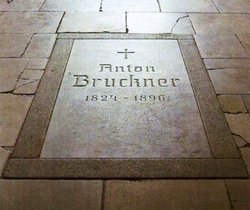
Bruckner's gravestone


The applause at the end from the Barbican audience after the Bruckner was long and enthusiastic, but stopped short of a standing ovation.  Probably about right.   In the end it was the concerti that struck one as closer to ideal.  Thinking back over the three partnerships with Lars Vogt, Truls Mork and Frank Peter Zimmermann, I wouldn’t change a single aspect of any of them.


Saturday, 30 November 2013

Luminous Mozart at Wimbledon Music Festival

Haydn String Quartet, Op. 20 No. 4
Mozart String Quartet No. 19 in C, K 465 "The Dissonance"
Beethoven String Quartet in E flat major, Op. 127

Quatuor Mosaiques

18 November 2013, St John's, Spencer Hill, Wimbledon, UK
***************

The programme was a balanced one of Haydn, Mozart and Beethoven.  One of the pleasures this enabled was witnessing the increased independence of the viola and cello as the evening progressed.  The cello's fairly perfunctory contributions to the Haydn, blossomed into the eloquence of the Mozart.  In the Beethoven the viola came alive. 
 

The concert served to underline three things.  The first, was the marvellous balance between individuality and team-work of Quatuor Mosaiques.  The luminous tone of their instruments and the mellow brilliance of Eric Hobarth's first violin the icing on the cake.  Second, what a supreme masterpiece Mozart’s Dissonance Quartet is, overflowing with wit, beauty and emotional eloquence. Third, what a fine thing that the Wimbledon Music Festival, can present A-grade ensembles like this in attractive acoustics at reasonable prices.  Bravo to all concerned.

Sunday, 6 October 2013

Vitality and verve from Orchestra Mozart

Beethoven: Leonora Overture No. 2, Op. 72a
Beethoven: Piano Concerto No. 2 in B flat, Op. 19
Beethoven: Symphony No. 4 in B flat, Op. 60


Orchestra Mozart

Bernard Haitink, conductor
Maria Joao Pires, piano

Bernard Haitink

Royal Festival Hall, London, 1 October 2013
***************

In the end Artistic Director Claudio Abbado was not able to join the Orchestra Mozart due to health concerns.  But impressive back-up came from the equally fine conductor Bernard Haitink and a splendid partner in soloist Maria Joao Pires.

This concert was a bizarrely managed bit of scheduling by London's Southbank Centre in which only the presence of Orchestra Mozart itself was a constant.  It started with an attractive Haydn/Mozart/Beethoven programme which then became all-Beethoven.  Then Pires dropped out as soloist to be replaced by Martha Argerich.  Abbado was subsequently forced to cancel his concerts for 2 months, including a tour of Japan.  Argerich simultaneously cancelled and Haitink stepped in at short notice with the suddenly available again Pires.

Orchestra Mozart is a chamber ensemble formed in 2004.  With Abbado as Artistic Director and Diego Matheuz as Principal Guest Conductor (he recently took up the same position with the Melbourne Symphony) it does not want for star conductors.  No doubt with this influence it also plays with the front rank of today's soloists.  And among its own ranks are some famous names such as Wolfram Christ, previously principal viola with the Berlin Philharmonic Orchestra.
Wolfram Christ


Pires, a gold standard these days in the classical piano concerti, was in vintage form in the Beethoven Second Piano Concerto after a slightly hard edged start.  Her finely pitched delivery of the hanging notes at the close of the slow movement was mesmerising.  


With youth and technical prowess combined, the Orchestra Mozart strings brought great verve and vigour to their playing, not least in a thrilling Egmont Overture served as an encore.  The woodwind added fine individuality in their contributions to leave only an overall sense that the darker aspects of the works were slightly underplayed.  However the sunny Fourth Symphony was a delight from beginning to end, and there was no want of drama and heroic Beethovenian struggle in the overtures that book-ended the concert and which Haitink shaped with a sure hand.  This season is Haitink’s 60th as conductor, during which he will turn 85.  Long may orchestras benefit from his wisdom. 

Pianist Maria Joao Pires

Martha Argerich - not available