Prom 57 - Bach feeds 5000
Wagner: Parsifal – Act 3 Prelude and Good Friday Music
Berg: Violin Concerto
Richard Strauss: Der Rosenkavalier – suite
Ravel: La valse
Gustav Mahler Jugendorchester
Daniele Gatti conductor
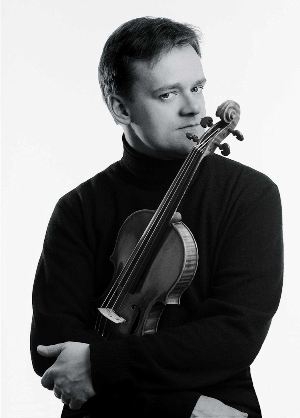
Frank Peter Zimmermann violin
26 August 2012, Royal Albert Hall, London
******************
The Gustav Mahler Youth Orchestra was founded in 1986 by Claudio Abbado and draws its members from the UK to Russia. With the normal Proms programme, concert-goers were handed a separate programme covering the GMYO's 2012 Summer Tour. Having two parallel programmes was actually quite instructive. The GMYO's was a heavily corporate production on the orchestra's 25th anniversary, complete with words from the sponsors, president etc, and even a rather earnest Mission Statement ("Talent with professionalism, Musicianship without borders, Dedication and enthusiasm", in case you were wondering). There were also some nice clashes: the GMYO was "the leading youth orchestra in the world" in its own brochure, but only "one of the world's leading youth orchestras" in the Proms programme.
 |
| Parsifal at Bayreuth in 2010 conducted by Daniele Gatti. Photo: Enrico Nawrath |
Gatti chose Wagner and Parsifal to open the concert. In 2010 he directed the opera at Bayreuth and is booked to return again to the Wagner mecca. The GMYO sections are impressive units, and Gatti coaxed a nicely blended sound out of the group as a whole, although some on the woodwind were rather under-projecting their solo lines. The concluding sections of this luminous music were beautifully shaped by conductor and orchestra.
 |
| Frank Peter Zimmermann |
 |
| Alban Berg |
With the Berg we were in for a treat with Frank Peter Zimmermann playing the solo part. Even after many listenings, Berg's melancholy and disturbing Violin Concerto has lost none of its mysterious power. Sub-titled "To The Memory of an Angel", it was composed following the death at 18 of the daughter of close friends. The heart of the work comes as Berg quotes Bach's chorale Es ist genug ("It is enough!") in the woodwind. And Bach reappeared, unexpectedly, as the highlight of the evening. Zimmermann delivered an encore, the gently rocking Andante of Bach's A Minor Solo Violin Sonata. It is music of simple, profound genius, and it was indescribably moving to see the Albert Hall - that 5000 capacity Colosseum - unified and transfixed by Zimmermann's hushed lullaby.
The second half brought a cavalcade of waltzes. First up was the pastiche of doubtful authenticity taken from Richard Strauss' opera Der Rosenkavalier. Here too the competing programme notes diverged. Did Strauss have no involvement in it and probably would have disliked it (Proms notes) or did he compose it possibly with some assistance from others such as Artur Rodzinski (GMYO notes)? Personally I prefer the Proms version, as Strauss would surely have loathed the way it does not follow his own poetic conclusion to the opera but instead reprises high spirits from Act 2, and some of the gear changes between contrasted operatic moments are laughably insensitive.
Things were taken to a whole extra level of sophistication with Ravel's masterwork La valse. It was conceived as a homage to the great waltzes of Johann Strauss, but the First World War intervened and by its completion in 1920 Ravel had rounded it off with a violent climax which breaks the waltz with a terse, military conclusion. It is a classic example (along with Bolero) of Ravel setting up a strictly rhythmic musical structure which then goes haywire at the end. The GMYO brought an impressive, lithe sophistication to the piece with excellent contributions from the brass section, but Gatti rushed his fences at the end which substituted a frenzy for what should be a shocking change of rhythm - a virtual waltz-murder.
Peter O'Byrne