Showing posts with label Witold Lutoslawski. Show all posts

Monday, 4 June 2018

Rattle says farewell to Berlin

Jörg Widmann: Tanz auf dem Vulkan (UK premiere)
Lutosławski: Symphony No.3
Brahms: Symphony No.1


Berliner Philharmoniker 
Simon Rattle conductor

31 May 2018, Royal Festival Hall, London *************
In 2018, Simon Rattle's tenure at the helm of the Berliner Philharmoniker comes to a close,  Rattle heads to the London Symphony Orchestra and Russian conductor Kirill Petrenko takes his place in Berlin. 

The last London concert for Rattle and the Berliners was a snap-shot of his life in Berlin.  Admirably championing newer music while accommodating the traditional core repertoire of this famous orchestra in intelligent if not life-changing interpretations.

No sooner had the orchestra finished tuning when it launched into a jazzy theme and on rushed Rattle with stagey expressions of annoyance.  Then the "proper" music was started.  Only at the end does the jazzy music return and conductor walk off stage while the orchestra finishes.  All nicely done in this short new work from Jörg Widmann: Tanz auf dem Vulkan ("Dance on the Volcano").

Then it was the Polish composer Witold Lutoslawski's Third Symphony, premiered in 1983.  It is a very fine work structured around a repeated motif with clear references to the famous opening of Beethoven's Fifth Symphony.  This returns to divide up the sections of the 30 minute piece, many of which thrillingly use "aleatory" writing where the players have freedom to play their sections at their own speeds.  It all culminates in an almost tonal climax of considerable emotion.  The performance was of great poise, clarity and virtuosity.

Johannes Brahms
And then to Brahms, his first symphony certainly not his best but whose outer movements pack a great emotional punch.  From the start the refinement of the orchestral sound was glorious, the strings very weighty and built from the double basses up in classic Brahmsian fashion.  Were the strings a little too numerous?  Perhaps at times they seemed to overpower the woodwind.  And then there was a developing concern that it was all a little rounded and cultured, albeit in a super-refined way. 


But no, we had simply been set up for the coda, the whole concert waiting for the final minutes when we were taken to another level and treated to a truly extraordinary sound: blended, bronzed and with seemingly infinite reserves of tonal depth and sonority.  It was engulfing, uplifting and more than a little awe-inspiring.  Thank you Berliner Philharmoniker.
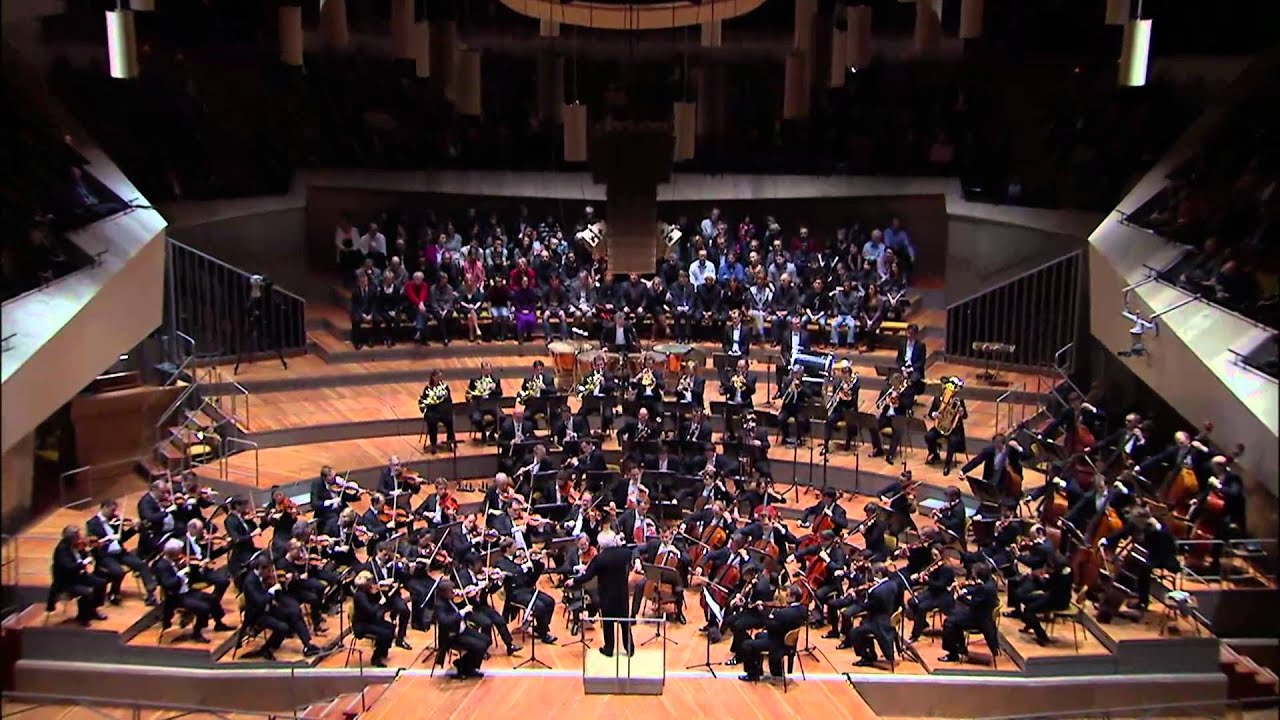
Sinon Rattle and the Berliner Philharmoniker

Saturday, 9 February 2013

Lutoslawski festival -  Salonen and Zimerman turn on the style 

Lutoslawski: Musique funebre
Lutoslawski: Piano Concerto
Ravel: Daphnis et Chloe ballet
 

Philharmonia Orchestra
Philharmonia Voices
Esa-Pekka Salonen conductor
Krystian Zimerman piano
 

30 January 2013, Royal Festival Hall, London
*********************


Lutoslawski with Salonen
Lutoslawski has been a particular favourite of mine since I discovered his stunning 3rd Symphony – Beethoven for the late 20th century.  So it is a particular pleasure that Esa-Pekka Salonen and his Philharmonia Orchestra are playing a full tribute to the Polish composer on the 100 year anniversary of his birth in 1913.
 

The first concert of three at the Royal Festival Hall kicked off with the work that grabbed international attention for the composer at the second Warsaw Autumn Festival in 1958.  The Musique funebre has a tone equivalent to Strauss’ Metamorphosen and commemorates the 10th anniversary of the death of Bela Bartok.  It remains an arresting composition and Salonen was a model of restraint, emphasising the subdued and intimate atmosphere it generates. 
 

Lutoslawski and Zimerman performing together
From this followed the much later Piano Concerto of 1988 and we were treated to a typically polished and prepared performance from the work’s dedicatee – Krystian Zimerman.  Lutoslawski first discussed the project with Zimerman in 1976 so it had an extended gestation.   Thinner, often luminous orchestration is coupled with much surprisingly traditional writing for the piano.  Zimerman evoked the sparse, probing opening with the crystalline beauty we have come to expect, and revelled in the passacaglia finale which contains writing of a Lisztian bent.  In between it was possible to imagine that Chopin or Brahms were involved, but Lutoslawksi’s characteristic structural clarity, superb orchestration and magica improvisatory qualities were everywhere evident.  Kissing the score, Zimerman departed the stage after an ideal performance of this fine work.

After such concise, focused brilliance in the first half, it was perhaps unfair to throw out one of Ravel’s most bloated scores.  Fair or not, Daphnis well outstayed its welcome, however brilliantly it was played and sung by the Philharmonia Orchestra and Voices.   The orchestration was at times ravishing of course, but much of the ballet feels like sub- Rimsky-Korsakov and the worldless vocalising of the chorus has not dated well.

Bring on more Lutoslawski!