Showing posts with label Brahms. Show all posts

Saturday, 4 May 2019

Janine Jansen scales the heights

Brahms: Violin Concerto
Bruckner: Symphony No.3 (vers. 1877) 
London Philharmonic Orchestra
Vladimir Jurowski conductor
Janine Jansen violin


Royal Festival Hall, London, 3 May 2019
**********************
The concert was billed as "Alpine Journeys", but inevitably the Festival Hall allowed not a bit of mist to develop around all those Brucknerian ostinati.  Jurowski's Bruckner was controlled, sculpted and with that acoustic, not a bit abrupt. Some of this effect may have come from the 1877 version of the symphony presented here by Jurowski.  The last movement in particular had more flow in the later 1889 revision. 


The frenzies were quite ferocious in the Scherzo and Finale but the polkas and landlers had no spring to them, and overall the effect was a little too literal, if thrillingly exact.

The real vistas of the evening came from Janine Jansen's Brahms.  The Brahms Violin Concerto, in a neat bit of programming, was premiered in 1879 and so nearly contemporaneous with the Bruckner.  Jansen plays with real muscle but is distinguished by her responsiveness to the music her fellow musicians, and her ability to inflect rhythm and tone from note to note.  Her high lines are clear but delicate and the lightness of tone brought to mind Ravel in the midst of Brahms.  Now that marks out a master violinist.


Janine Jansen


Monday, 4 June 2018

Rattle says farewell to Berlin

Jörg Widmann: Tanz auf dem Vulkan (UK premiere)
Lutosławski: Symphony No.3
Brahms: Symphony No.1


Berliner Philharmoniker 
Simon Rattle conductor

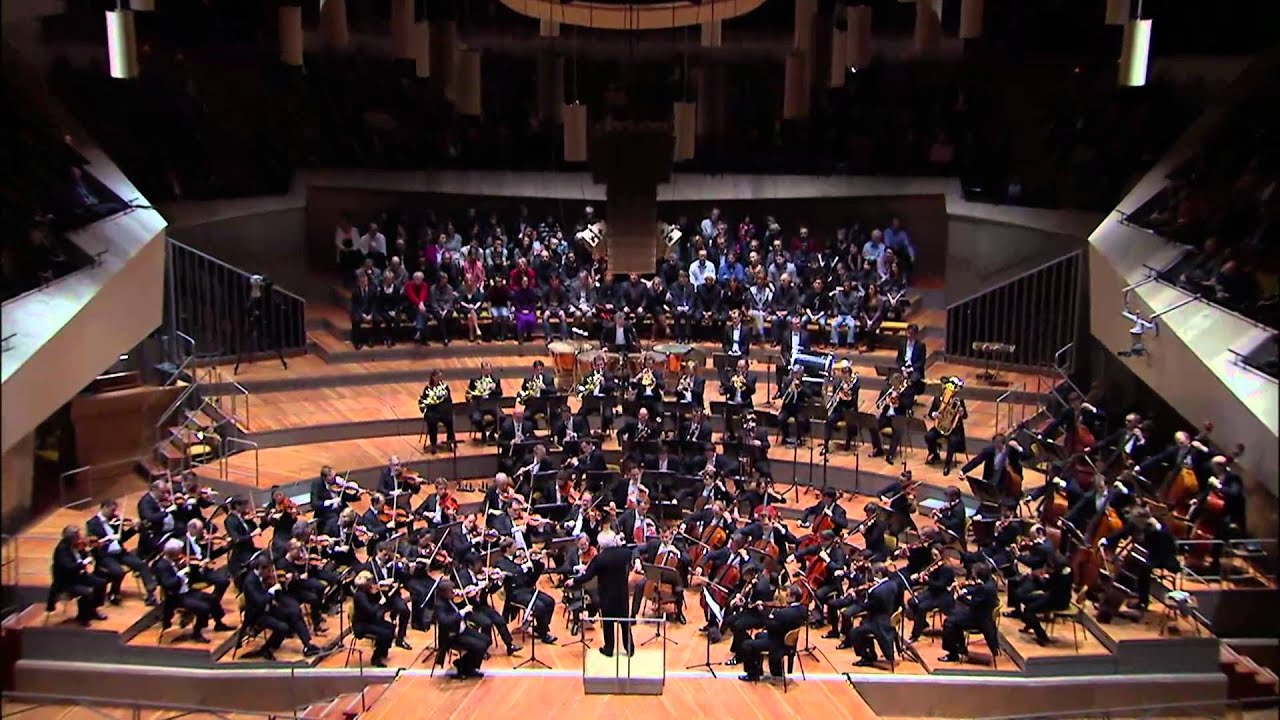
31 May 2018, Royal Festival Hall, London *************
In 2018, Simon Rattle's tenure at the helm of the Berliner Philharmoniker comes to a close,  Rattle heads to the London Symphony Orchestra and Russian conductor Kirill Petrenko takes his place in Berlin. 

The last London concert for Rattle and the Berliners was a snap-shot of his life in Berlin.  Admirably championing newer music while accommodating the traditional core repertoire of this famous orchestra in intelligent if not life-changing interpretations.

No sooner had the orchestra finished tuning when it launched into a jazzy theme and on rushed Rattle with stagey expressions of annoyance.  Then the "proper" music was started.  Only at the end does the jazzy music return and conductor walk off stage while the orchestra finishes.  All nicely done in this short new work from Jörg Widmann: Tanz auf dem Vulkan ("Dance on the Volcano").

Then it was the Polish composer Witold Lutoslawski's Third Symphony, premiered in 1983.  It is a very fine work structured around a repeated motif with clear references to the famous opening of Beethoven's Fifth Symphony.  This returns to divide up the sections of the 30 minute piece, many of which thrillingly use "aleatory" writing where the players have freedom to play their sections at their own speeds.  It all culminates in an almost tonal climax of considerable emotion.  The performance was of great poise, clarity and virtuosity.

Johannes Brahms
And then to Brahms, his first symphony certainly not his best but whose outer movements pack a great emotional punch.  From the start the refinement of the orchestral sound was glorious, the strings very weighty and built from the double basses up in classic Brahmsian fashion.  Were the strings a little too numerous?  Perhaps at times they seemed to overpower the woodwind.  And then there was a developing concern that it was all a little rounded and cultured, albeit in a super-refined way. 


But no, we had simply been set up for the coda, the whole concert waiting for the final minutes when we were taken to another level and treated to a truly extraordinary sound: blended, bronzed and with seemingly infinite reserves of tonal depth and sonority.  It was engulfing, uplifting and more than a little awe-inspiring.  Thank you Berliner Philharmoniker.
Sinon Rattle and the Berliner Philharmoniker

Tuesday, 2 June 2015

Brahms from Budapest

Wolfgang Amadeus Mozart: Overture, The Magic Flute 
Wolfgang Amadeus Mozart: Piano Concerto No.9 in E flat, K.271 
Johannes Brahms: Symphony No.1

Budapest Festival Orchestra 
Iván Fischer conductor 
Maria João Pires piano

Royal Festival Hall, London, 20 May 2015
*******************


Maria Joao Pires
This fantastic orchestra again brought an enormously cultured and intelligent programme to London’s Royal Festival Hall.

The opening Magic Flute overture of Mozart set the bar high.  The interpretation was detailed and well prepared.  Phrases were rounded with care, and sonorities were rich without losing the essential lightness of touch that this work requires.

With Maria Joao Pires as soloist in the Mozart 9th concerto there was never going to be a turn towards heaviness after the overture.  Pires draws you in, her simplicity of utterance feeling almost radical. In the chamber-like interplay between soloist and orchestra in the last movement Pires and Fisher were in their element; fine musicians, totally engaged in the score.  Her luminous encore from Schumann's Waldszenen rounded off her performance in true Pires fashion: eloquent, humble, haunting.

If one was to have any doubts about the exalted nature of the evening, it was the Brahms First Symphony that provided them.  Fisher and the Budapest players have a thoroughly considered view of this score.  Each phrase and detail was placed within an overall arc to the interpretation.  These are the kind of qualities you get from a Mariss Jansons or Krystian Zimerman also.  However there was a nagging suspicion that for all its sonic beauty and sculpted phrases and paragraphs, the last movement lacked a sense of abandonment when required.  Can surging excitement in music be so carefully prepared?

The encore was just wonderful.  The musicians put down their instruments and began to swap positions.  It then became clear the men and women were dividing into two halves standing around the conductor’s podium.  Fisher then directed the orchestra – now a choir – in an a capella Brahms motet.  The Budapest Festival Orchestra never fail to delight.

Saturday, 2 November 2013

Kavakos and Chailly bring rapturous close to Gewandhausorchester residency

Brahms Violin Concerto in D, Op. 77
Brahms Symphony No 4 in E Minor, Op. 98

Gewandhausorchester Leipzig
Riccardo Chailly
conductor 

Leonidas Kavakos violin

30 October 2013, Barbican Hall, London
*************

The four concert Brahms cycle presented by Ricardo Chailly and his Leipzig Gewandhaus Orchestra over the last week concluded on Wednesday with the same exalted levels of musicianship as the previous evenings.

Which is the greatest romantic violin concerto?  Well the Brahms sits at the top or high on anyone's list.  From simple opening to thrilling acceleration into the march rhythm coda in the finale, this concerto rather tends to knock all comers for six. How would Leonidas Kavakos fare after his patchy participation in last week's Double Concerto? 
Leonidas Kavakos

Well, it was happily an experience of an entirely different order. The Gewandhausorchester opened the concerto with quiet simplicity and a very broad tempo.  From his first entry Kavakos was precise and hyper-sensitive to his every note and Chailly the most intensely collaborative of conductors. This culminated in a daringly broad but completely riveting cadenza of the first movement, delivered to a raptly silent Barbican.  The orchestra re-entered rolling out the most fabulous of sonic magic carpets while Kavakos' violin soared over the top.  Perfection.

The Andante that followed reminded us that other great soloists were in the hall.  The Gewandhausorchester's principal oboe, not for the first time during this Barbican residency,  opened with a ridiculously creamy solo.  It was something of a disappointment when the violin had to take over the melody.  The entire woodwind section of the Gewandhausorchester play with a distinctive group sound: rich, even plummy, and with a heightened expressiveness that constantly brings to mind the human voice.

And we should have known that anyone who, like Kavakos, has played Paganini's own 18th century Guarneri violin (nicknamed "Il Cannone"!), would be in touch with his demonic side.  The Allegro finale abounded in gypsy abandon and thrilled to the end.  Together with Volodos the previous week, this Brahms cycle has featured two soloists in the very top bracket.

After we had recovered during the interval, these Leipzig evenings concluded with Brahms' most taught and tense symphony - the Fourth.  Not one to loiter to long over an interlude, Chailly's directness brought huge emotional drive to the first movement's climax with the french horns implacable.  By contrast, the famous flute solo in the Allegro energico was intensely expressive, indeed delivered in a flexible almost operatic style in striking contrast to the streamlined approach to the rest of the Passacaglia finale.  A thrilled Barbican audience acclaimed this wonderful orchestra's achievement.


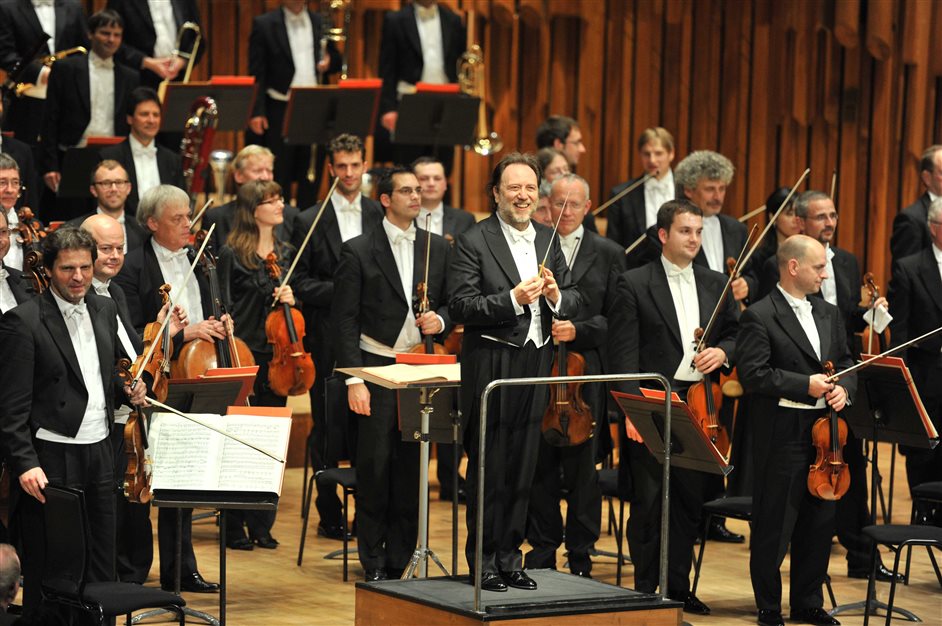
Ricardo Chailly
Looking back over these concerts, this was clearly a great orchestra at the top of its game.   The level of preparation of the symphonies was also exceptional.  Maybe in London we are a touch too prepared to accept our orchestras winging it a little?  This Leipzig orchestra demonstrated the benefits of having a clear and well rehearsed conception of the work, combined with focus and verve on the night.

Then there are the virtues of Chailly's Brahms: mid-weight, lithe and sleek - combined with the tone, transparency and balance of this Leipzig band.  This delivered the most spectacular benefits in the First Symphony which can get a bit bloated in other conductor's hands.    

And ironically Chailly's overall directness of utterance and refusal to slacken the pace delivered some of its biggest payloads at the moments where there was pause for thought.  The most prominent of these were the solos from the woodwind in the andantes of the First and Fourth Symphonies, and Volodos and the orchestra together at the end of the Second Piano Concerto's Andante.  And then there was Kavakos and the Gewandhausorchester in the close of the Violin Concerto's first movement; a transcendant moment beyond criticism.

Tuesday, 29 October 2013

Chailly's Brahms cycle opens at the Barbican

Brahms Double Concerto in A Minor, Op. 102
Brahms Symphony No 1 in C Minor, Op. 68
 

Gewandhausorchester Leipzig
Riccardo Chailly
Gewandhauskapellmeister
Leonidas Kavakos violin

Enrico Dindo cello

22 October 2013, Barbican, London
*************

One of the highlights of this London season is the Brahms Symphonies and Concertos cycle of Ricardo Chailly and his Leipzig Gewandhaus Orchestra.  This orchestra is one of Europe’s most venerable with a history stretching back over 200 years.  Along the way it also has connections  to Brahms himself via Arthur Nikisch who directed the orchestra's first Brahms cycle in 1913/14 and who Brahms heard conduct his symphonies.  

Johannes Brahms
Cellist Enrico Dindo
Concert 1 of the 4 started with the Double Concerto and First Symphony.  Leonidas Kavakos and Enrico Dindo were the intermittently engaging soloists in the concerto, and forcefully projected the heroic elements in the score.  Kavakos I have heard before but Dindo was new, bringing a strong sense of personality to his playing and highlighting the feeling of recitative and aria that underpins much of the writing.  Less successful were the more chamber aspects of this work.  The orchestral contribution was very fine as we have come to expect from previous visits, although the woodwind sounded unusually distant relative to the strings and soloists.  A conscious effect?

"I shall never write a symphony" Brahms stated, aged 37.   And the First Symphony had a famously long gestation period.  It was all Beethoven's fault.  "You've no idea what it feels like with such a giant marching behind you" he said.  Nevertheless after 21 years and much encouragement, this majestic work was premiered.

Chailly’s Brahms is highly distinctive.  Not for him the dense, monumental effects of others.  His hallmarks are a sound of shape, transparency,  rhythmic spring, and strong onward momentum.  This performance of Brahms' First Symphony was clearly very well rehearsed.  The orchestra and conductor have just released a recording of the 4 symphonies and are in the middle of touring them to London, Vienna, Paris etc… At times Chailly exaggerated the indicating of entries from sections, as if to say “Look what a delicious detail we have drawn out here!”  But I should not be ungrateful.  There were frequent moments when the ear marvelled at a neatly rounded off phrase here, a smooth gear change there.  All was targeted towards maximising the transparency and balance of the sound, revealing detail and lifting the rhythm.  The pizzicato from the eight double basses was as notable as their wonderful growling pedal notes.  The sound from the string sections was at times so smoothly and sumptuously toned it seemed to be lifting the orchestra into a realm of Ideal Brahmsian performance.  

There were three moments that made the jaw drop.  In the thick of the first movement’s tumultuous development the sequence of gleaming entries thrown amongst the various string sections shone like silver. Then the great melody of the finale sounded as fresh as the day it was written. And the glorious coda?  Well this delivered the night’s biggest thrill when the orchestra accelerated dramatically into the final pages.  

Ricardo Chailly and the Leipzig Gewandhausorchester at the Barbican