Wednesday, 31 May 2017

Concentus Musicus Wien farewell the Brahmsaal

Joseph Haydn
Symphony No. 59 in A Major "Fire"
Piano Concerto in D
Violin Concerto in C
Symphony No. 45 in F sharp minor "Farewell"

Concentus Musicus Wien
Erich Hobarth, violin
Stefan Gottfried, piano

Musikverein Brahmsaal, Vienna, 28 May 2017.
*************

On the strength of this concert Concentus Musicus Wien remains in rude health, despite the absence of its legendary late music director Nikolaus Harnoncourt.  Its harpsichordist Stefan Gottfried is the current music director and the ensemble has great quality across the board.

This was well illustrated by the superb musicianship of both Mr Gottfried and Erich Hobarth, who stepped up from the ensemble to give their accounts of two well known Haydn concerti. Impeccable, expressive and (as one might expect) beautifully in-tune to the orchestra around them. 

The musical highlight was the Fire Symphony, surely one of Haydn's best.  Concentus Music attacked from the word go, the period strings' gutsy tone added to the taut drama as did the horns terse interjections.  The flow and fun of the finale was quite ideal.  Irresistable.
The Brahmsaal, Musikverein
For the final work, the Haydn Farewell Symphony was given. At the famous premiere, Haydn's Esterhazy orchestra each walked off stage as they concluded their parts in a protest at how long they were being kept from their families.  This bit of theatre was here repeated.

Before the performance, Mr Gottfried spoke.  Concentus Musicus had long felt that it should again be performing in the Great "Golden" Hall of the Musikverein.  Its next season would again be in the Goldener Saal, so here was their farewell to the more intimate Brahmsaal.  On the strength of this performance, richly deserved.
The Musikverein facade, Vienna


Monday, 15 May 2017

Respighi from the Orchestra of Santa Cecilia

Rossini: Overture, The Siege of Corinth
Tchaikovsky: Piano Concerto No.1
Respighi: Fountains of Rome; Pines of Rome 
Orchestra of Santa Cecilia Rome
Sir Antonio Pappano conductor
Yuja Wang piano
Royal Festival Hall, London, 11 May 2017
******************
Antonio Pappano's Santa Cecilia orchestra has been making its mark on the international scene in recent years, but the orchestra's history goes back over a century to 1908.  Its string sound is on the lean side but with plenty of texture; a natural platform for an outstanding set of woodwind soloists.  The repertoire was focused on Italy, with a Rossini overture to start (always welcome) and the better two of the Roman Tryptich of Respighi.  This orchestra has special claims to these pieces having premiered them both in the early twentieth century.  It is highly pictorial music, from its depictions of flowing water to the moods of dawn and dusk.  There was no doubting the sensitivity of Pappano's approach and the superb contributions of his woodwind.  For the ground-pounding conclusion with the Roman Legions marching in triumph into Rome, Pappano stationed the brass high around the hall for extra surround sound effect.  A cinematic touch for the music that launched a thousand movie soundtracks.
 
Antonio Pappano conducts the Santa Cecilia Orchestra

A wonderfully withdrawn Valse Triste of Sibelius led into Rossini concluding the evening with the second encore of the William Tell overture.

Earlier, Yuja Wang had displayed all her supersonic piano technique in the Tchaikovsky piano concerto.  Tchaikovsky wrote a notoriously episodic concerto, and Pappano and Wang did nothing to fix that particular problem.  All moments were given their full indulgence, whether rapt reflection or thunderous attack.  Anything resembling an onward musical flow was lost, from which the big loser was the conclusion of the first movement which was stripped of all majesty and became yet another moment of display.  As so often the second movement fared well and Wang was genuinely thrilling in the finale.  The encores were memorable: a very fine Schubert/Liszt Gretchen at the Spinning Wheel, and then the jazzed up hyper-virtuoso version of Mozart's Rondo all Turca was a show stopper for which an inevitable ovation followed.

Sunday, 7 May 2017

Santtu-Matias Rouvali on the rise

Smetana Vltava from Má Vlast
Elgar Cello Concerto
Holst The Planets

Santtu-Matias Rouvali conductor
Alban Gerhardt cello
Leicester University Chamber Choir
Leicester Bach Choir

23 April 2017, Royal Festival Hall, London
*************
Santtu-Matias Rouvali

Santtu-Matias Rouvali was a new name for me, but most certainly one to watch.  The Finnish conductor is about to take up the directorship of the Gothenburg Symphony and here gave plenty of reasons to understand why.

He has a great shock of blond hair and a very demonstrative conducting style with arms high and expressive.  He has an excellent ear for orchestral balance and the evening was littered with fine interpetative moments which showed careful preparation.  One such was during the great tune from Jupiter in The Planets when he scaled back the strings to bring out a woodwind chorale.  Vltava also benefited from a genuine interpretative vision, sounding as fresh as the day of its premiere in Rouvali's hands.

Sunday, 30 April 2017

Anna Netrebko throwing thunderbolts

Tchaikovsky: Eugene Onegin

Anna Netrebko, Tatiana
Petter Mattei, Onegin
Alexey Dolgov, Lenski
Alexey Dolgov sings the role of Lenski, and Robin Ticciati conducts. - See more at: https://www.curzoncinemas.com/film-info/met-opera-tchaikovskys-eugene-onegin#sthash.CVaST5DU.dpuf
Elena Maximova, Olga Stefan Kocan, Gremin

Metropolitan Opera Chorus and Orchestra
Robin Ticciati, conductor

22 April 2017, The Metropolitan Opera New York, live cinema broadcast
**************
Anna Netrebko as Tatiana
One of the advantages of the Met's live broadcasts is having Renee Fleming speak with the cast, often seconds after having finished an Act.  Poor conductor Robin Ticciati was waylaid in his room when he clearly just wanted to get up to his orchestra for Act III (he arrived late). 

This being Tchaikovsky's famous opera of the even more famous Pushkin novel, various Russian singers were asked the obvious question: explain for a worldwide audience what Onegin means to you.  Apart from its ubiquity on the school curriculum, none left us any the wiser.   

Similarly, we had to take the emotional intensity of the opera's plot on faith in this performance much of the time.  Why does Onegin stir such volcanic feelings in Tatiana?  Why does Onegin change his mind so dramatically in Act III?  Ill health had removed Dmitri Hvorostovsky from the line-up for this performance alongside Anna Netrebko.  Taking his place was Peter Mattei, sure of voice but a stolid acting presence.  Perhaps this was the prime reason why the emotional and dramatic logic of the evening was not always clear. 

Alexey Dolgov's Lenski was on surer ground, and Netrebko's Tatiana a brilliant thing.  The letter scene was magnificently paced, and at its conclusion overwhelming, Netrebko's voice throwing thunderbolts out into the house.

So, an evening filled with very fine singing, but with more uneven acting.  The setting was the usual Met traditional and true to the original.  Although was that a conceptual landscape at the end?  The palace setting for the ball combined with the frozen lake from the duel.  What will the upper east side say? 
Anna Netrebko, Dmitri Hvorostovsky, Štefan Kocán, Alexey Dolgov, Elena Maximova - See more at: https://www.curzoncinemas.com/film-info/met-opera-tchaikovskys-eugene-onegin#sthash.CVaST5DU.dpuf

Saturday, 4 March 2017

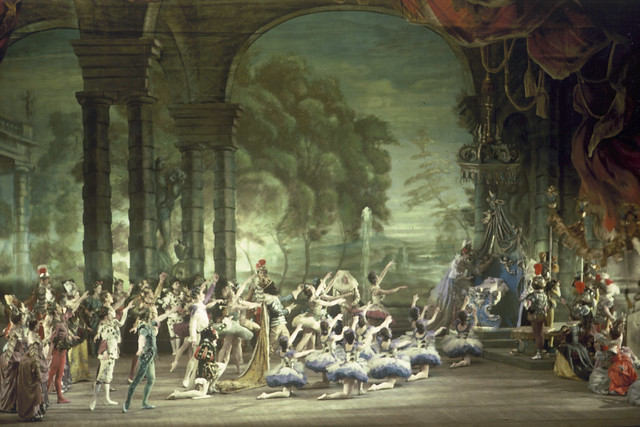
The Sleeping Beauty circa 1946 re-awakened

Tchaikovsky: The Sleeping Beauty

Marianela McGorian, Princess AuroraVadim Muntagirov, Prince Florimund
Kristen McNally, Carabosse
Claire Calvert, Lilac Fairy

The Royal Ballet 
Orchestra of the Royal Opera House
Koen Kessels, conductor
 28 February 2017, The Royal Opera House, London simulcast
***************

A Royal Ballet classic given some sensitive updating from the iconic 1946 production that re-opened the Royal Opera House after the Second World War.  Marianela McGorian was imperious and technically impregnable, even if not the image of a girlish 16 year old.  Claire Calvert a radiant Lilac Fairy.  This pinnacle of all classic ballets was most satisfying in its "signature" production from the Royal Ballet. 
The Sleeping Beauty 1946 Royal Ballet production

Saturday, 25 February 2017

Jonas Kaufmann's Die Walküre

Richard Wagner
Prelude to Tristan und Isolde
Wesendock
Lieder
Act I from Die Walküre 

Jonas Kaufmann tenor
London Symphony Orchestra
Jonas Kaufmann
Antonio Pappano conductor
Karita Mattila soprano
Eric Halfvarson bass

Barbican Hall, London, 8 February 2017
*******************

Jonas Kaufmann's Barbican residency across 4 concerts continued with a much-anticipated Wagner evening.  And it was inevitably the Walkure First Act that dominated proceedings. 

For this he was joined by the no less formidable Karita Mattila as well as Pappano leading the LSO.  The LSO threw us into a most vivid storm after which we heard Kaufmannn's Siegmund emerge.  This was sophisticated Wagner, marked by an intensely lyrical line.  How glorious to hear the role properly sung, rather than shouted.  Wintersturme never sounded more beautiful.

The down-side was that a truly heroic impact was missing from the closing pages of this wonderful slow-burner of an Act. For some true Wagnerian abandon one had to turn to Mattila.  She was less in control, more squally, but delivered an authentic emotional punch.  Standing next to her, both in physical and vocal gesture, Kaufmann gave the impression of pacing himself and guarding his voice for the concerts to come.  That said, the cries of Walse, Walse were thrillingly sustained.

For the evening's complete performance Eric Halfvarson's Hunding was surely as close to ideal as it is possible to hope for.  From cracking bottom notes to physical menace he dominated everything he did.  Not even the weird placement of Pappano directly between him and the other two soloists could spoil the dramatic effect.

Pappano may not be a master of the long line, but the LSO built up a great head of steam in the exhilarating conclusion. Could someone not have set up the singers a more comfortable distance from his podium and those arms so frequently whirling like windmills?   In the first half, the Tristan Prelude did not catch fire but the Wesendonk Lieder again showed off the fine, lyrical beauty of Kaufmann's sophisticated tenor voice.  

Karita Mattila


Sunday, 5 February 2017

Martha Argerich: supreme musician

Aram Khachaturian: Adagio of Spartacus and Phrygia, Dance of the Gaditanian Maidens and Victory of Spartacus, Spartacus, Suite No.1 & 2.
Sergey Prokofiev: Piano Concerto No.3
Dmitry Shostakovich: Symphony No.5 in D minor

St Petersburg Philharmonic Orchestra
Yuri Temirkanov, conductor
Martha Argerich, piano

Royal Festival Hall, London,
*****************

This spectacular concert offered Russia's pre-eminent orchestra playing a Shostakovich symphony which it premiered in 1937. If that was not enough, they were joined by the legendary Martha Argerich for the Prokofiev Third Concerto - a work which no-one on the planet plays better. 
Martha Argerich, then.  Photo: Priska Ketterer
Unlike some other ageing virtuosi, Argerich remains in magnificent shape.  Now in her 70s, her fingers retain their steel and how her hands flicker and flash over the keys.  Her musicianship can genuinely be described as a wonder - instinctive, in the moment, of the greatest sensitivity and alive to every nuance in the score and the musicians around her. 

Her Prokofiev is close to an ideal with its power, lyricism and subtlety.  One example can suffice: in the last moment after the orchestra blooms into a lush melody Prokofiev "steps on the throat of his own song" as the piano enters with a mysterious and pointedly sarcastic interlude.  What introspection and shades of colour Argerich provided here: mesmerising. 
Martha Argerich, now.  Photo: Neumeister

Such is Argerich's reputation for cancellations the packed Hall was cheering as she came on stage.  Famous pianists abounded in the audience,  Nikolai Lugansky and Stephen Kovacevich among them. At the end all were on their feet.  Taking her bows, and afterwards backstage, she seemed more relaxed than in years past.  We were treated to Liszt's arrangement of Schumann's song Widmung as an encore.  

After the interval, the St Petersburgh gave a powerful Shostakovich Fifth.  It was a broad interpretation from Temirkanov, lacking the last ounce of intensity from where I was sitting.  The pay off came in the third movement Largo which underlined the romantic underpinnings of this giant of 20th century music.  
Evgeny Mravinsky who conducted the premiere of Shostakovich's 5th Symphony, together with the composer.
It was left to the encore to display the full glory of the St Petersburgh strings, the conclusion of Prokofiev's Cinderella ballet showing off a bottomless tonal depth to the sound.  Quite awesome and a fitting conclusion to a most memorable afternoon.
The St Petersburgh Philharmonic at home.