Sunday, 7 May 2017

Santtu-Matias Rouvali on the rise

Smetana Vltava from Má Vlast
Elgar Cello Concerto
Holst The Planets

Santtu-Matias Rouvali conductor
Alban Gerhardt cello
Leicester University Chamber Choir
Leicester Bach Choir

23 April 2017, Royal Festival Hall, London
*************
Santtu-Matias Rouvali

Santtu-Matias Rouvali was a new name for me, but most certainly one to watch.  The Finnish conductor is about to take up the directorship of the Gothenburg Symphony and here gave plenty of reasons to understand why.

He has a great shock of blond hair and a very demonstrative conducting style with arms high and expressive.  He has an excellent ear for orchestral balance and the evening was littered with fine interpetative moments which showed careful preparation.  One such was during the great tune from Jupiter in The Planets when he scaled back the strings to bring out a woodwind chorale.  Vltava also benefited from a genuine interpretative vision, sounding as fresh as the day of its premiere in Rouvali's hands.

Sunday, 30 April 2017

Anna Netrebko throwing thunderbolts

Tchaikovsky: Eugene Onegin

Anna Netrebko, Tatiana
Petter Mattei, Onegin
Alexey Dolgov, Lenski
Alexey Dolgov sings the role of Lenski, and Robin Ticciati conducts. - See more at: https://www.curzoncinemas.com/film-info/met-opera-tchaikovskys-eugene-onegin#sthash.CVaST5DU.dpuf
Elena Maximova, Olga Stefan Kocan, Gremin

Metropolitan Opera Chorus and Orchestra
Robin Ticciati, conductor

22 April 2017, The Metropolitan Opera New York, live cinema broadcast
**************
Anna Netrebko as Tatiana
One of the advantages of the Met's live broadcasts is having Renee Fleming speak with the cast, often seconds after having finished an Act.  Poor conductor Robin Ticciati was waylaid in his room when he clearly just wanted to get up to his orchestra for Act III (he arrived late). 

This being Tchaikovsky's famous opera of the even more famous Pushkin novel, various Russian singers were asked the obvious question: explain for a worldwide audience what Onegin means to you.  Apart from its ubiquity on the school curriculum, none left us any the wiser.   

Similarly, we had to take the emotional intensity of the opera's plot on faith in this performance much of the time.  Why does Onegin stir such volcanic feelings in Tatiana?  Why does Onegin change his mind so dramatically in Act III?  Ill health had removed Dmitri Hvorostovsky from the line-up for this performance alongside Anna Netrebko.  Taking his place was Peter Mattei, sure of voice but a stolid acting presence.  Perhaps this was the prime reason why the emotional and dramatic logic of the evening was not always clear. 

Alexey Dolgov's Lenski was on surer ground, and Netrebko's Tatiana a brilliant thing.  The letter scene was magnificently paced, and at its conclusion overwhelming, Netrebko's voice throwing thunderbolts out into the house.

So, an evening filled with very fine singing, but with more uneven acting.  The setting was the usual Met traditional and true to the original.  Although was that a conceptual landscape at the end?  The palace setting for the ball combined with the frozen lake from the duel.  What will the upper east side say? 
Anna Netrebko, Dmitri Hvorostovsky, Štefan Kocán, Alexey Dolgov, Elena Maximova - See more at: https://www.curzoncinemas.com/film-info/met-opera-tchaikovskys-eugene-onegin#sthash.CVaST5DU.dpuf

Saturday, 4 March 2017

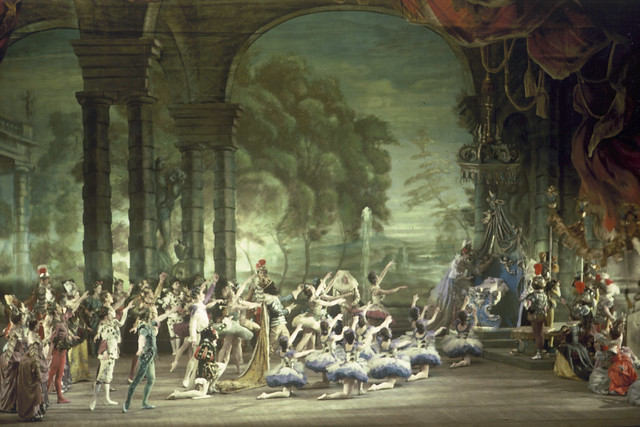
The Sleeping Beauty circa 1946 re-awakened

Tchaikovsky: The Sleeping Beauty

Marianela McGorian, Princess AuroraVadim Muntagirov, Prince Florimund
Kristen McNally, Carabosse
Claire Calvert, Lilac Fairy

The Royal Ballet 
Orchestra of the Royal Opera House
Koen Kessels, conductor
 28 February 2017, The Royal Opera House, London simulcast
***************

A Royal Ballet classic given some sensitive updating from the iconic 1946 production that re-opened the Royal Opera House after the Second World War.  Marianela McGorian was imperious and technically impregnable, even if not the image of a girlish 16 year old.  Claire Calvert a radiant Lilac Fairy.  This pinnacle of all classic ballets was most satisfying in its "signature" production from the Royal Ballet. 
The Sleeping Beauty 1946 Royal Ballet production

Saturday, 25 February 2017

Jonas Kaufmann's Die Walküre

Richard Wagner
Prelude to Tristan und Isolde
Wesendock
Lieder
Act I from Die Walküre 

Jonas Kaufmann tenor
London Symphony Orchestra
Jonas Kaufmann
Antonio Pappano conductor
Karita Mattila soprano
Eric Halfvarson bass

Barbican Hall, London, 8 February 2017
*******************

Jonas Kaufmann's Barbican residency across 4 concerts continued with a much-anticipated Wagner evening.  And it was inevitably the Walkure First Act that dominated proceedings. 

For this he was joined by the no less formidable Karita Mattila as well as Pappano leading the LSO.  The LSO threw us into a most vivid storm after which we heard Kaufmannn's Siegmund emerge.  This was sophisticated Wagner, marked by an intensely lyrical line.  How glorious to hear the role properly sung, rather than shouted.  Wintersturme never sounded more beautiful.

The down-side was that a truly heroic impact was missing from the closing pages of this wonderful slow-burner of an Act. For some true Wagnerian abandon one had to turn to Mattila.  She was less in control, more squally, but delivered an authentic emotional punch.  Standing next to her, both in physical and vocal gesture, Kaufmann gave the impression of pacing himself and guarding his voice for the concerts to come.  That said, the cries of Walse, Walse were thrillingly sustained.

For the evening's complete performance Eric Halfvarson's Hunding was surely as close to ideal as it is possible to hope for.  From cracking bottom notes to physical menace he dominated everything he did.  Not even the weird placement of Pappano directly between him and the other two soloists could spoil the dramatic effect.

Pappano may not be a master of the long line, but the LSO built up a great head of steam in the exhilarating conclusion. Could someone not have set up the singers a more comfortable distance from his podium and those arms so frequently whirling like windmills?   In the first half, the Tristan Prelude did not catch fire but the Wesendonk Lieder again showed off the fine, lyrical beauty of Kaufmann's sophisticated tenor voice.  

Karita Mattila


Sunday, 5 February 2017

Martha Argerich: supreme musician

Aram Khachaturian: Adagio of Spartacus and Phrygia, Dance of the Gaditanian Maidens and Victory of Spartacus, Spartacus, Suite No.1 & 2.
Sergey Prokofiev: Piano Concerto No.3
Dmitry Shostakovich: Symphony No.5 in D minor

St Petersburg Philharmonic Orchestra
Yuri Temirkanov, conductor
Martha Argerich, piano

Royal Festival Hall, London,
*****************

This spectacular concert offered Russia's pre-eminent orchestra playing a Shostakovich symphony which it premiered in 1937. If that was not enough, they were joined by the legendary Martha Argerich for the Prokofiev Third Concerto - a work which no-one on the planet plays better. 
Martha Argerich, then.  Photo: Priska Ketterer
Unlike some other ageing virtuosi, Argerich remains in magnificent shape.  Now in her 70s, her fingers retain their steel and how her hands flicker and flash over the keys.  Her musicianship can genuinely be described as a wonder - instinctive, in the moment, of the greatest sensitivity and alive to every nuance in the score and the musicians around her. 

Her Prokofiev is close to an ideal with its power, lyricism and subtlety.  One example can suffice: in the last moment after the orchestra blooms into a lush melody Prokofiev "steps on the throat of his own song" as the piano enters with a mysterious and pointedly sarcastic interlude.  What introspection and shades of colour Argerich provided here: mesmerising. 
Martha Argerich, now.  Photo: Neumeister

Such is Argerich's reputation for cancellations the packed Hall was cheering as she came on stage.  Famous pianists abounded in the audience,  Nikolai Lugansky and Stephen Kovacevich among them. At the end all were on their feet.  Taking her bows, and afterwards backstage, she seemed more relaxed than in years past.  We were treated to Liszt's arrangement of Schumann's song Widmung as an encore.  

After the interval, the St Petersburgh gave a powerful Shostakovich Fifth.  It was a broad interpretation from Temirkanov, lacking the last ounce of intensity from where I was sitting.  The pay off came in the third movement Largo which underlined the romantic underpinnings of this giant of 20th century music.  
Evgeny Mravinsky who conducted the premiere of Shostakovich's 5th Symphony, together with the composer.
It was left to the encore to display the full glory of the St Petersburgh strings, the conclusion of Prokofiev's Cinderella ballet showing off a bottomless tonal depth to the sound.  Quite awesome and a fitting conclusion to a most memorable afternoon.
The St Petersburgh Philharmonic at home.

Saturday, 28 January 2017

Jurowski keeps his nerve amidst uneven Fidelio

Beethoven : Fidelio (Semi-staged, with an English narration)
 
Anja Kampe, Leonore
Ben Johnson, Jaquino
Kristinn Sigmundsson, Rocco
Pavlo Hunka, Don Pizarro
Robert Dean Smith, Florestan
Ronan Collett, Don Fernando
Sofia Fomina, Woglinde

Simon Williams, narrator
Helen Ryan, narrator
Daniel Slater, director 

Vladimir Jurowski, conductor
London Philharmonic Orchestra
London Voices

21 January 2017, Royal Festival Hall, London
*****************

As ever with this opera, Beethoven's massive musical strength and belief in his message trumped all limitations.  The final choral frenzy fairly blazed with joy and hope as the London Voices lined up at the front with the soloists.

There was more than a little relief that we'd made it.  At the end of Act 1, the audience had witnessed an opera presented as a rehearsal with faux-relaxed soloists sprawled behind the orchestra and the director on stage giving instructions.  The orchestra was in civvies with Jurowski sitting on the floor as the auditorium filled up. The message seemed to be, these people are just like us. And indeed, the 1st Act is primarily domestic melodrama, with an underlying dramatic tension provided be Leonore's presence in disguise as a boy, searching for her husband. 

Vladimir Jurowski
More disturbingly, two narrators hovered, offering reflective commentary on the action and the character's psychological states.  It might have worked. After all Bach used a similar effect in the St Matthew Passion, and Fidelio has more than a passing resemblance to an oratorio.  Others have gone down this track before, notably I saw a spectacular Fidelio at the Proms with an Edward Said penned commentary.


But not with the half-baked philosophy of the text this time around, and the night's increasingly shambolic delivery by the narrators.  Was that the silliest thing I just heard on the Festival Hall stage, or did the actor just mess up her line? Pizzaro didn't get enough love as a child.  He was a forerunner of Stalin and Eichmann.  Even a random quote from Tertullian. 

Thankfully the splendid musical virtues of the evening could not be obscured, particularly in Act 2 when all on stage returned with more formal dress and presentation in keeping with the opera's turn to the serious.  Jurowski directed a taut and edgy Act 2 overture and turned up the heat even more for the finale.  Kristinn Sigmundsson's towering presence as Rocco was, more than usual, the fulcrum of the drama and Robert Dean Smith, stepping in at late notice, a subtle Florestan even if a bit tight of voice.

And there was Anja Kampe, the most committed of soloists.  Her every London appearance is a pleasure and her Leonore was unmissable, even if she occasionally strained at the top of her register.  She was every inch the hero of the opera.
Anja Kampe

This was the first concert in a Southbank series "Belief and Beyond Belief".  Jurowski wanted to start with a humanist masterpiece rather than an explicitly religious one.  He and director marked out Hope as the focus of the piece. Who could disagree, and we all need a bit of that in today's world. 

Sunday, 22 January 2017

Placido Domingo sings Nabucco

Verdi: Nabucco

Liudmyla Monastyrska, Abigaille
Jamie Barton, Fenena
Russell Thomas, Ismaele
Placido Domingo, Nabucco
Dmitry Belosselskiy, Zaccaria

James Levine, conductor
Metropolitan Opera Orchestra and Chorus

7 January 2017,  The Metropolitan Opera New York, live cinema broadcast
***************
Placido Domingo as Nabucco
Placido Domingo has for some years now been taking on baritone roles after his tenor voice weakened.  Now in his 70s, the voice carries less burnished metal and heft, but Domingo's greatness has always rested on a charismatic and acting talent equal to his technical musical gifts.

He can most certainly still act and carry a stage, is quite wonderfully musical, and the voice too communicates with ease


Around him were more powerful, youthful voices, not least the impressive Liudmyla Monastyrska.   Though of quality they seemed a little cumbersome in comparison.  Or was that the Met Live close miking again, making almost everyone sound like a belter.

In the pit was James Levine, it would appear now wheelchair bound.  The commentary at interval stated Domingo and Levine had done over 1000 performances at the Met together.  As Levine had introduced Nabucco back into the Met's reportoire, it was a fitting choice.  The production was Met-lavish as we have come to expect, and critically the chorus was splendid throughout.  Their rendition of the famous slaves chorus more than justified its immediate repeat.